🌍TranslationSelect language → Select text → Click "Translate".

Discharge or hospital admission?

History

Current complaints

  • Epigastric pain for approx. 2 hours
  • Radiating to the shoulder
  • Pain onset at rest
  • No improvement since onset

Important negatives

  • No chest pain
  • No dyspnea
  • No nausea
  • No vomiting
  • No fever
  • No cough
  • No syncope
  • No palpitations
  • No trauma

Past medical history

  • No known pre-existing conditions

Medications

  • No regular medications

Allergies

  • None known

Substance use

  • No relevant information

Family history

  • Unremarkable

Physical examination

The patient is awake, oriented and in good general condition.

Vital signs

  • Blood pressure: 120/70 mmHg
  • Pulse: 140/Min
  • Respiratory rate: 14/min
  • Temperature: 37,0 °C
  • Oxygen saturation: 97 % (room air)

Clinical findings

  • Heart: regular rhythm, no abnormal heart sounds
  • Lungs: vesicular breath sounds bilaterally, no crackles
  • Abdomen: soft, no guarding, mild epigastric tenderness
  • Extremities: no edema, peripheral pulses palpable
EKG
Fachleiter.org
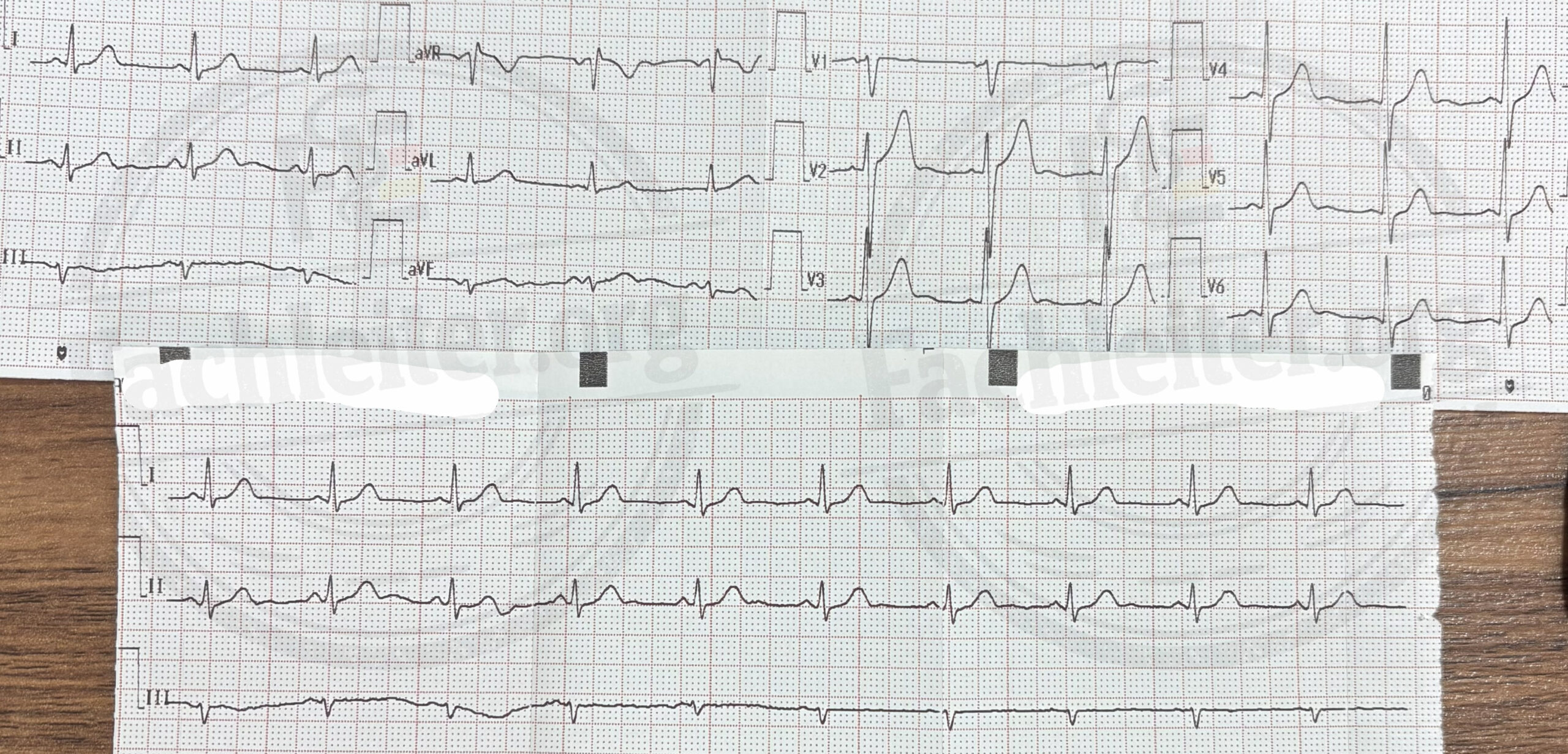
Fachleiter.org
 

ECG Summary

  • Rhythm: regular R-R intervals.
  • Heart rate: distance between two R waves is almost 4 large boxes → 300 / 4 ≈ 75/min → normal heart rate.
  • P waves: positive in lead II and negative in aVR → sinus rhythm.
  • PR interval: within the normal range.
  • QRS complex: narrow (< 120 ms).
  • ST segment: no elevations or depressions.
  • T waves: no pathological changes.
  • R wave progression: normal.

Interpretation

  • Sinus rhythm with normal heart rate.
  • Unremarkable atrioventricular and intraventricular conduction.
  • No electrocardiographic evidence of acute ischemia or ST-elevation myocardial infarction.
  • Overall unremarkable resting ECG.

Important: An unremarkable ECG does not exclude an acute coronary syndrome, especially an NSTEMI or unstable angina pectoris. Assessment must always be made together with history, the clinical picture, serial troponin measurements and, if necessary, follow-up ECGs.

Decision: Due to ongoing epigastric pain radiating to the shoulder, there was suspicion of an acute coronary syndrome despite an unremarkable ECG. As troponin testing was not available at our facility, the patient was referred to a hospital for further evaluation.

Leave a Comment

Your email address will not be published. Required fields are marked *

Scroll to Top