
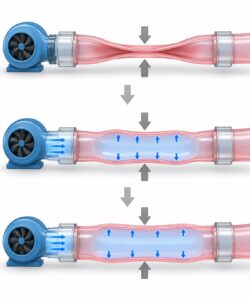
Task: Describe the sequence of images using the following keywords. Explain how the overpressure keeps the soft tube open and how this principle can be applied to CPAP therapy.
Keywords: soft tube – external pressure – collapse – air supply – continuous overpressure – keeping open – upper airways – inhalation and exhalation – prevention of breathing pauses.
Obstructive sleep apnea
In obstructive sleep apnea (OSA), the upper airways repeatedly narrow or collapse during sleep. This can lead to drops in oxygen and brief arousals. Affected individuals usually do not notice these themselves.
An apnea in adults is defined as lasting at least ten seconds. Crucial is the number of apneas and hypopneas per hour of sleep, the apnea–hypopnea index (AHI). For the diagnosis, the following are commonly used:
-
AHI ≥ 5 per hour with typical symptoms or relevant comorbidities.
-
AHI ≥ 15 per hour even without corresponding symptoms.
Partners often report loud, irregular snoring, observed breathing pauses and subsequent gasping for air.
Other possible complaints are:
-
Nighttime awakenings with shortness of breath or palpitations.
-
Restless sleep, sweating and frequent nighttime urination.
-
Dry mouth and morning headaches.
-
Non-restorative sleep and pronounced daytime sleepiness.
-
Concentration problems and reduced performance.
Microsleeps can increase the risk of accidents in road traffic and at the workplace.
The main risk factors include overweight, fat deposition in the neck area, anatomical narrowings in the pharynx, enlarged tonsils and a retruded lower jaw. Alcohol and certain sleep or sedative medications can worsen the condition.
With increasing age the probability of OSA rises. Age-related changes of tissue and muscular stabilization of the upper airways contribute to this.
Untreated OSA is associated with arterial hypertension, atrial fibrillation and other cardiovascular diseases. Metabolic disorders such as insulin resistance and type 2 diabetes also commonly coexist. Morning headaches are typical; a general worsening of migraine should not, however, be presented as a confirmed consequence without reservation.
Evaluation includes self- and partner history as well as a physical examination. Body weight, neck circumference, upper airways and comorbidities are considered, among other things.
In an appropriate constellation an outpatient cardiorespiratory polygraphy is performed first. It records, among other things, airflow, respiratory movements, oxygen saturation and heart rate.
Polysomnography in a sleep laboratory is the most comprehensive examination. It additionally records sleep stages and arousals and is especially required in unclear findings, complex comorbidities or suspected other sleep disorders.
Treatment depends on severity, symptoms and comorbidities.
General measures
-
Weight reduction in overweight individuals.
-
Regular exercise and sufficient sleep duration.
-
Avoidance of alcohol, especially in the evening.
-
If OSA is positional, positional therapy may be considered.
-
Medical review of respiratory-depressant or strongly sedating medications.
Sleep and sedative medications should not be taken independently. However, medications already prescribed should not be discontinued without medical consultation.
CPAP therapy
CPAP therapy is a central treatment, especially for pronounced or symptomatic OSA. A continuous positive airway pressure is generated via a mask that keeps the upper airways open during sleep. This can significantly reduce breathing pauses and daytime sleepiness.
Further options
Depending on the findings, a mandibular advancement device, selected surgical procedures or hypoglossal nerve stimulation may be considered.
Obstructed nasal breathing, for example due to nasal polyps, should also be evaluated and treated. Treatment of nasal obstruction alone, however, does not reliably eliminate existing OSA. Good sleep hygiene supports treatment but does not replace a necessary specific therapy.
Case
- History
- Physical examination
- Suspected diagnosis
- Differential and accompanying diagnoses
- Further procedure
- New Tab
My name is Christoph Hoch. I am 49 years old and have been constantly tired for months. I actually sleep seven or eight hours but feel exhausted in the morning. I often have headaches right after getting up. During the day I have poor concentration and sometimes nod off while watching TV. Coffee makes me feel somewhat better.
My wife says that I snore very loudly. Sometimes I don’t breathe for a while and then suddenly gasp for air. I do not notice these breathing pauses myself.
I weigh 117 kilograms at 1.80 meters. In recent years I have gained a lot of weight because I eat unhealthily. I often eat large portions, a lot of fast food and snacks in between. In the evenings I frequently eat late in front of the TV.
I also often have heartburn and belch acid. Especially after large meals and when I lie down afterwards, it burns behind my breastbone. Sometimes I get an acidic taste in my mouth. For this I take a tablet of pantoprazole 20 mg in the morning as needed. That makes the symptoms better. I have no difficulty swallowing. I have not noticed blood in vomit or black stools.
I also suffer from migraine. Because I had attacks more often, I was prescribed propranolol three months ago. I take 40 mg twice daily. Currently I have a mild attack about every two months. I rarely exercise.
I have no swollen legs. I also do not experience sudden palpitations with heavy sweating.
I am a non-smoker. In the evenings I drink a glass of wine. I also use cannabis, which increases my appetite.
49-year-old patient in a wakeful, cooperative state, oriented to all qualities. Obese nutritional status with a body weight of 117 kg and a height of 180 cm, corresponding to a BMI of 36.1 kg/m².
- Vital signs: Blood pressure 128/82 mmHg, pulse 62/min and regular, respiratory rate 14/min, oxygen saturation 97 % on room air, body temperature 36.6 °C.
- Head and neck: Neck circumference 46 cm. With mouth opening and tongue protrusion the soft palate and uvular base are visible, but the posterior pharyngeal wall is not, corresponding to Mallampati class III. Palatine tonsils mildly enlarged bilaterally, without redness or coatings. Nasal breathing patent bilaterally.
- Heart: Regular heart action, clear heart sounds, no auscultatory murmurs.
- Lungs: Symmetric thoracic excursion, vesicular breath sounds bilaterally, no crackles and no wheeze.
- Abdomen: Markedly increased abdominal adipose tissue. Abdomen soft, mild tenderness in the epigastrium, no guarding. Normal bowel sounds.
- Extremities: No lower leg edema, peripheral pulses palpable and symmetric.
- Neurological examination: Speech clear, pupils isocoric and reactive to light bilaterally. No pareses, symmetric sensation, steady gait.
The most likely diagnosis is obstructive sleep apnea with pronounced daytime sleepiness. Particularly indicative are the repeated breathing pauses with subsequent gasping observed by his wife and the loud snoring. This is consistent with non-restorative sleep despite adequate sleep duration, the morning headaches, concentration problems and unintended falling asleep while watching TV.
Obesity grade II with a BMI of 36.1 kg/m², a neck circumference of 46 cm and limited space in the pharynx increase the likelihood of upper airway obstruction during sleep. The fact that Mr Hoch does not notice the breathing pauses himself does not argue against the diagnosis. An oxygen saturation of 97 % in the awake state also does not rule it out.
The diagnosis and its severity must be confirmed by a sleep medicine examination. Severity cannot be reliably inferred from symptoms alone.
Medication- and substance-related fatigue
Propranolol can cause fatigue and reduced exercise capacity. Cannabis and evening alcohol consumption can further impair attention and sleep quality. These factors can aggravate his complaints but do not adequately explain the observed breathing pauses and pronounced snoring. It is important whether the fatigue increased after starting propranolol.
Hypothyroidism and anemia
Both conditions are possible additional causes of fatigue. Weight gain could speak for hypothyroidism, although Mr Koch already gives a plausible dietary history. Typical other complaints such as cold intolerance or constipation have not been described so far. Anemia is not particularly likely based on the current information but can be checked with a blood count.
Migraine and sleep-apnea-associated headaches
The well-known migraine must be distinguished from the morning headaches. If these occur predominantly immediately after waking, are bilateral and pressing, and subside during the day, this rather suggests sleep apnea–associated headaches. Unilateral, pulsating pain with nausea and sensitivity to light or noise is more indicative of a migraine attack. Both headache types can occur simultaneously.
Gastroesophageal reflux disease
A gastroesophageal reflux disease is likely as a comorbid diagnosis. This is indicated by heartburn, acid regurgitation and a sour taste in the mouth, especially after large meals and when lying down. Obesity and late eating promote the complaints.
- Ambulatory cardiorespiratory polygraphy: airflow, respiratory movements, oxygen saturation, heart rate and body position. The decisive factors are the frequency of respiratory events, the oxygen desaturations and the distinction between obstructive and central events.
(If the findings are unclear, polysomnography: additionally sleep stages, actual sleep time and arousals.) - Epworth Sleepiness Scale: extent of daytime sleepiness.
- Laboratory: blood count, TSH, HbA1c, lipid profile, creatinine and bicarbonate.
In addition, tendency to fall asleep while driving, cannabis and alcohol use, and a possible relationship of the fatigue to propranolol are queried.
Ambulatory cardiorespiratory polygraphy – example report for the case:
Recording duration 7 hours and 12 minutes. Apnea–hypopnea index based on recording time: 34 events per hour, predominantly obstructive apneas and hypopneas with preserved respiratory effort. Mean oxygen saturation 93%, lowest oxygen saturation 81%. During 8% of the recording time oxygen saturation is below 90%. Marked snoring, increase of respiratory events in the supine position. No relevant central apnea component.
PAP therapy
Mr. Koch will receive a CPAP or APAP device with an individually fitted mask. The required pressure will be adjusted by sleep medicine. He should use the device during the entire sleep period, including for a nap.
An initial check takes place within six weeks. Daytime sleepiness, usage duration, mask leaks and remaining respiratory events are assessed. If complaints persist, mask fit and pressure settings are reviewed.
Weight reduction and everyday measures
With a baseline weight of 117 kg, an initial weight loss of 6–12 kg within six to twelve months is targeted. Mr. Hoch will receive dietary counseling. Specifically, smaller portions, less fast food and avoiding sweets in front of the TV are agreed. Additionally he will start brisk walks of 20–30 minutes on five days per week.
He should refrain from the evening wine and cannabis. He should not take sleep or sedative medications without medical consultation. If uncontrollable tendency to fall asleep persists, he must not drive any vehicle until effective treatment.
Treatment of reflux complaints
Because of frequent heartburn, Mr. Koch will initially take pantoprazole 20 mg once daily, 30–60 minutes before breakfast, for four weeks. Thereafter the effect and further treatment needs will be reviewed.
He should eat smaller evening meals and leave at least three hours between the last meal and lying down. For nocturnal complaints the head of the bed will be elevated.
Review of propranolol
Propranolol 40 mg twice daily is initially continued because of its good effect on migraine. If the fatigue remains despite effective PAP therapy, a possible medication-related contribution will be evaluated and migraine prophylaxis adjusted if necessary.
CPAP/ APAP
Task: Explain to Mr. Koch in simple words how to use each device at home. Avoid technical terms.
CPAP: Turn the device on – put on the mask – check the fit – constant air pressure – keep the airways open – continue breathing calmly – every night for the entire sleep period – cleaning.
APAP: Turn the device on – put on the mask – check the fit – automatically adjusted air pressure – adapts to the need – keep the airways open – continue breathing calmly – every night for the entire sleep period – cleaning.
Basics
An apnea denotes a temporary interruption of breathing. It can occur once or repeatedly. Recurrent pauses in breathing during sleep are called sleep apnea. A reduced, but not completely interrupted breathing is called hypopnea.
Central apnea
In central apnea the respiratory drive temporarily ceases. Respiratory control is carried out by neuronal networks in the brainstem, particularly in the medulla oblongata and the pons. These influence respiratory rhythm and depth.
During a central respiratory pause both airflow and respiratory movements of the chest and abdomen are absent. Causes include diseases of the central nervous system, traumatic brain injury, heart failure or respiratory-depressant substances such as opioids.
Obstructive apnea
In obstructive apnea the respiratory drive continues, but the upper airways are temporarily blocked. Despite respiratory effort, insufficient air reaches the lungs. Causes include relaxation of the pharyngeal muscles during sleep, enlarged tonsils or anatomical narrowings (a small, retruded lower jaw, an enlarged tongue or an elongated soft palate).
In young infants short pauses in breathing can occur as part of periodic breathing. Especially in preterm infants respiratory regulation is still immature.
Longer respiratory pauses or shorter pauses accompanied by oxygen desaturation, bradycardia, bluish skin discoloration or reduced responsiveness are not to be regarded as harmless and must be medically assessed immediately. Different evaluation criteria apply to infants than to adults.
Cheyne–Stokes respiration is a periodic breathing pattern: breaths become progressively deeper, then shallower and finally lead into a central respiratory pause. The cycle then begins again.
Cheyne–Stokes respiration can occur particularly in heart failure, after stroke and in advanced renal insufficiency.