
Medical history interview
- Greeting and brief introduction
- Personal data
- Current complaints
- Accompanying chest complaints
- Previous episodes
- Symptoms after palpitations
- Other complaints
- Past medical history
- Surgeries and hospitalizations
- Medications
- Allergies and intolerances
- Social history
- Substance use and drugs
- Family history
- Summary + Further management
👨⚕️ Hello, my name is Dr. Schneider. I am responsible for you today. Before we begin: How may I address you?
👨 Hello. My name is Thomas Berger.
👨⚕️ Mr. Berger, I would first like to ask you some questions about your complaints and your health. Is that okay with you?
👨 Yes, of course.
👨⚕️ How old are you?
👨 I am 60 years old.
👨⚕️ How tall are you and how much do you weigh?
👨 I am 1.78 meters tall and weigh about 82 kilos.
👨⚕️ Do you live alone or with someone?
👨 I live with my wife.
👨⚕️ Who is your general practitioner?
👨 My GP is Dr. Wagner. Unfortunately I don’t have the phone number with me.
👨⚕️ What brings you to us today?
👨 Since this morning I have had severe palpitations. I also had a pressure sensation in my chest.
👨⚕️ When did the complaints start?
👨 About five hours ago.
👨⚕️ Did the palpitations start suddenly or gradually?
👨 Very suddenly. My heart started beating very fast from one moment to the next.
👨⚕️ What were you doing when it started?
👨 I was sitting at my desk working on the computer.
👨⚕️ Were you physically active or particularly excited?
👨 No. There was no particular trigger.
👨⚕️ Did the heartbeat feel rather regular or irregular?
👨 Very fast, but regular. It felt like a fast thumping.
👨⚕️ Were you able to measure your pulse?
👨 My smartwatch showed about 160 beats per minute.
👨⚕️ Was the palpitations present continuously since the start?
👨 No, not the whole time. In between it got better, then the palpitations suddenly started again.
👨⚕️ Did the palpitations disappear completely in between or only become weaker?
👨 They only became weaker. Sometimes my heart slowed down again, but shortly afterwards the palpitations began again.
👨⚕️ How do you feel now?
👨 I feel a bit weak and slightly dizzy. My heart now feels unusually slow.
👨⚕️ Have you lost consciousness?
👨 No. After the palpitations ended I only briefly had my vision go black.
👨⚕️ You mentioned a pressure sensation in your chest. Where exactly did you feel it?
👨 In the middle of my chest.
👨⚕️ Can you describe the sensation more precisely?
👨 It was a slight pressure during the palpitations, not a really strong pain.
👨⚕️ How severe was the pressure on a scale from zero to ten?
👨 About three out of ten.
👨⚕️ Did the pressure radiate to the arm, back, neck or jaw?
👨 No.
👨⚕️ Was the pressure present the whole time?
👨 No, it appeared a while after the palpitations. Since the palpitations stopped it has completely disappeared.
👨⚕️ Did the pressure get worse with physical exertion, on inhaling or with movement?
👨 No.
👨⚕️ Did you have shortness of breath?
👨 During the palpitations I felt I could not take a deep breath. Now I can breathe normally again.
👨⚕️ Did you have nausea, vomiting or cold sweats?
👨 No.
👨⚕️ Have you had similar complaints before?
👨 Yes, in recent months I have had sudden palpitations several times.
👨⚕️ How often did this occur so far?
👨 About four or five times.
👨⚕️ How long did these episodes last?
👨 Mostly ten to twenty minutes. Afterwards the palpitations stopped on their own.
👨⚕️ Did these episodes also start and stop suddenly?
👨 Yes, always very suddenly.
👨⚕️ Did the heartbeat feel fast and regular during those episodes as well?
👨 Yes, just like today, only not as long.
👨⚕️ Were there any specific triggers?
👨 No. Most of the time I was completely calm.
👨⚕️ Did you do anything to stop the palpitations?
👨 Once I took a deep breath, held it and pressed hard. Shortly afterwards the palpitations stopped. But I don’t know if it was because of that.
👨⚕️ Have these complaints ever been medically evaluated?
👨 No. Because the palpitations always stopped on their own, I haven’t gone to the doctor so far.
👨⚕️ How do you usually feel immediately after such an episode?
👨 Most of the time I suddenly feel very weak and a bit dizzy.
👨⚕️ Have you ever measured your pulse afterwards?
👨 Yes. My smartwatch once showed only about 40 beats per minute.
👨⚕️ How long did the pulse remain that slow?
👨 About a few minutes. Afterwards I felt better again.
👨⚕️ Have you ever lost consciousness during this?
👨 No, but once I had to sit down immediately because my vision went dark.
👨⚕️ Do you feel dizzy independently of these episodes?
👨 Occasionally. Especially in the morning when getting up.
👨⚕️ Have you noticed unusual fatigue or reduced exercise tolerance in recent months?
👨 Yes, I get tired faster than before. When climbing stairs I sometimes have to stop briefly.
👨⚕️ Have you noticed swollen legs?
👨 No.
👨⚕️ Do you have to get up at night because of breathlessness or sleep with multiple pillows?
👨 No.
👨⚕️ Have you had fever, cough or an infection recently?
👨 No.
👨⚕️ Have you noticed tremor, heavy sweating, diarrhea or unintended weight loss?
👨 No.
👨⚕️ Are any diseases known to you?
👨 No, so far I have been basically healthy.
👨⚕️ Have you ever been diagnosed with high blood pressure, diabetes, a thyroid disease or a heart disease?
👨 No.
👨⚕️ Is a cardiac arrhythmia already known in you?
👨 No.
👨⚕️ Have you ever had surgery?
👨 No.
👨⚕️ Have you ever been hospitalized before?
👨 Only once many years ago because of a sports injury.
👨⚕️ Do you take medications regularly?
👨 No.
👨⚕️ Have you taken anything today because of the complaints?
👨 No.
👨⚕️ Do you take dietary supplements or herbal preparations?
👨 No.
👨⚕️ Do you have allergies or do you not tolerate certain medications?
👨 No, not that I know of.
👨⚕️ What do you do for a living?
👨 I work as an accountant.
👨⚕️ Can you manage your daily life independently?
👨 Yes, without problems.
👨⚕️ Do you exercise regularly?
👨 I go for a walk two to three times a week. Otherwise I don’t do sports.
👨⚕️ Do you smoke?
👨 No, I have never smoked.
👨⚕️ Do you drink alcohol?
👨 No.
👨⚕️ Do you use drugs or stimulant substances?
👨 No.
👨⚕️ Do you drink a lot of coffee or energy drinks?
👨 I drink one cup of coffee in the morning. I don’t drink energy drinks.
👨⚕️ Are there cardiovascular diseases in your family?
👨 My father had a heart attack at age 72.
👨⚕️ Are arrhythmias or pacemakers known in your family?
👨 My mother received a pacemaker at an older age. I don’t know exactly why.
👨⚕️ Were there sudden deaths in younger ages in your family?
👨 No.
👨⚕️ Mr. Berger, I will summarize briefly: About five hours ago you experienced a very fast, regular heartbeat that started suddenly. During that time you had a slight pressure sensation in your chest. The palpitations stopped spontaneously shortly before the examination. Afterwards you noticed a slow heart rate, weakness and dizziness. You have had similar but shorter episodes several times before. Is that correct?
👨 Yes, exactly.
👨⚕️ Your symptoms are suggestive of a paroxysmal cardiac arrhythmia. After the end of the palpitations your heart appears to have been temporarily unusually slow. To determine the exact cause we need to examine and monitor your heart rhythm.
We will now check your blood pressure, pulse and oxygen saturation and immediately perform an ECG. Additionally we will draw blood and examine, among other things, electrolytes, thyroid values and, to be safe, cardiac enzymes. Afterwards we will monitor your heart rhythm continuously. An echocardiogram and, if necessary, a long-term ECG or further cardiological investigations are also required.
Examination
Vital signs
| Parameter | Findings |
|---|---|
| Blutdruck | 130/76 mmHg |
| Puls | 155/min, regular |
| Atemfrequenz | 17/min |
| Sauerstoffsättigung | 98 % on room air |
| Körpertemperatur | 36,6 °C |
| Blutzucker | 120 mg/dl |
| GCS | 15 points |
Physical examination
General condition:
60-year-old patient in mildly reduced general condition and normal nutritional status. Awake, fully oriented and cooperative. Appears slightly restless due to the palpitations. No cyanosis, no dyspnea at rest.
Cardiovascular system:
Cardiac action tachycardic and regular at about 155/min. Heart sounds clear, no pathological murmurs. Peripheral pulses palpable bilaterally. Capillary refill under two seconds. No jugular venous distension and no peripheral edema.
Lungs:
Vesicular breath sounds bilaterally. No crackles, no wheeze and no other adventitious sounds. Symmetric ventilation.
Thorax:
Thorax symmetric. No pressure or percussion pain. The reported pressure sensation is not reproducible on palpation.
Abdomen:
Abdominal wall soft. No tenderness, no guarding. Bowel sounds normal. Liver and spleen not palpably enlarged.
Brief neurological exam:
Pupils isocoric and reactive to light. No facial palsy, no speech disturbance and no focal neurological deficits. Strength and sensation symmetric. Patient currently not unconscious, but reports mild dizziness.
Assessment of circulatory status:
Regular tachycardia with stable blood pressure. Currently no clinical signs of hemodynamic instability or acute heart failure.
ECG
Summary
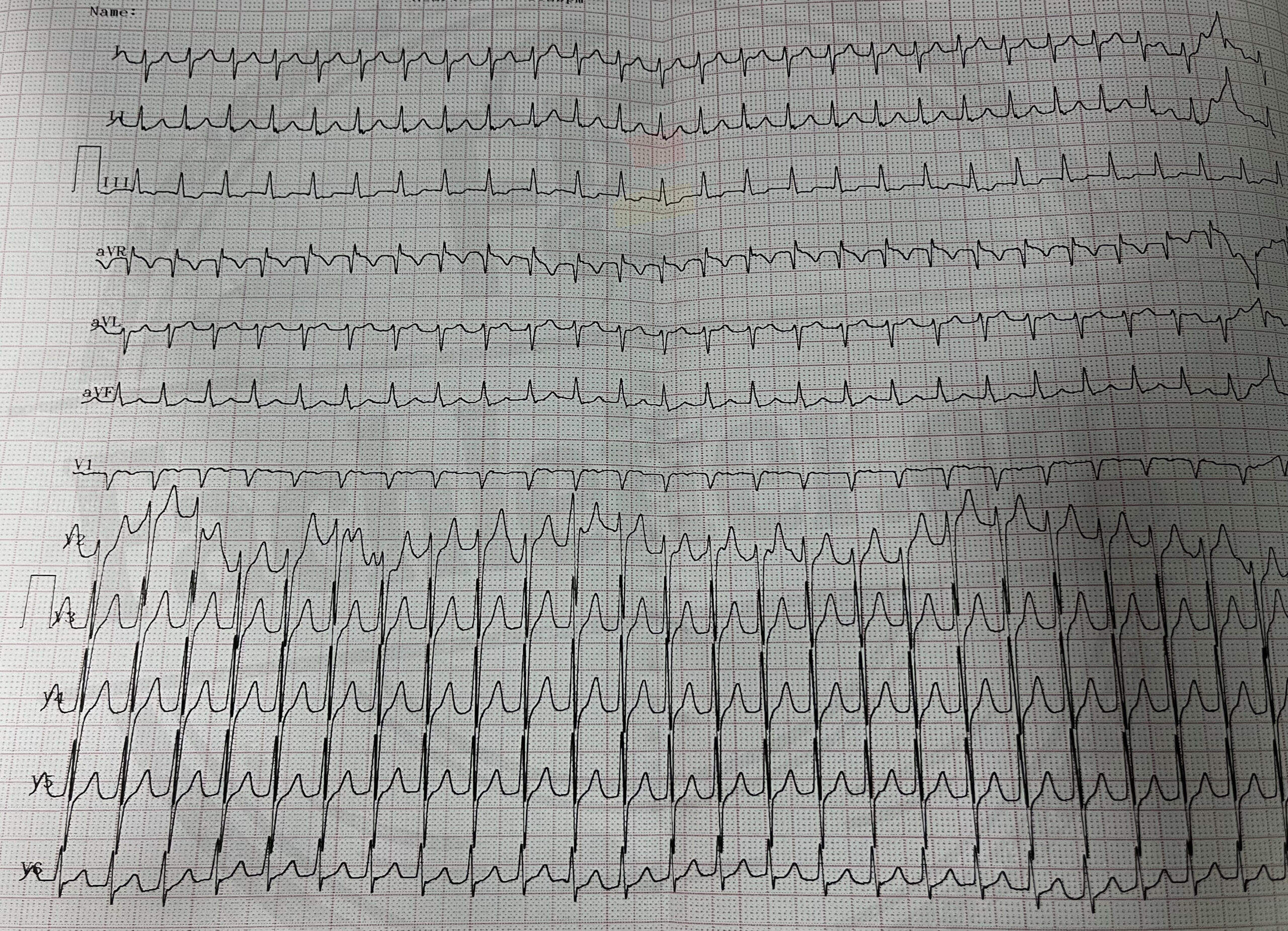
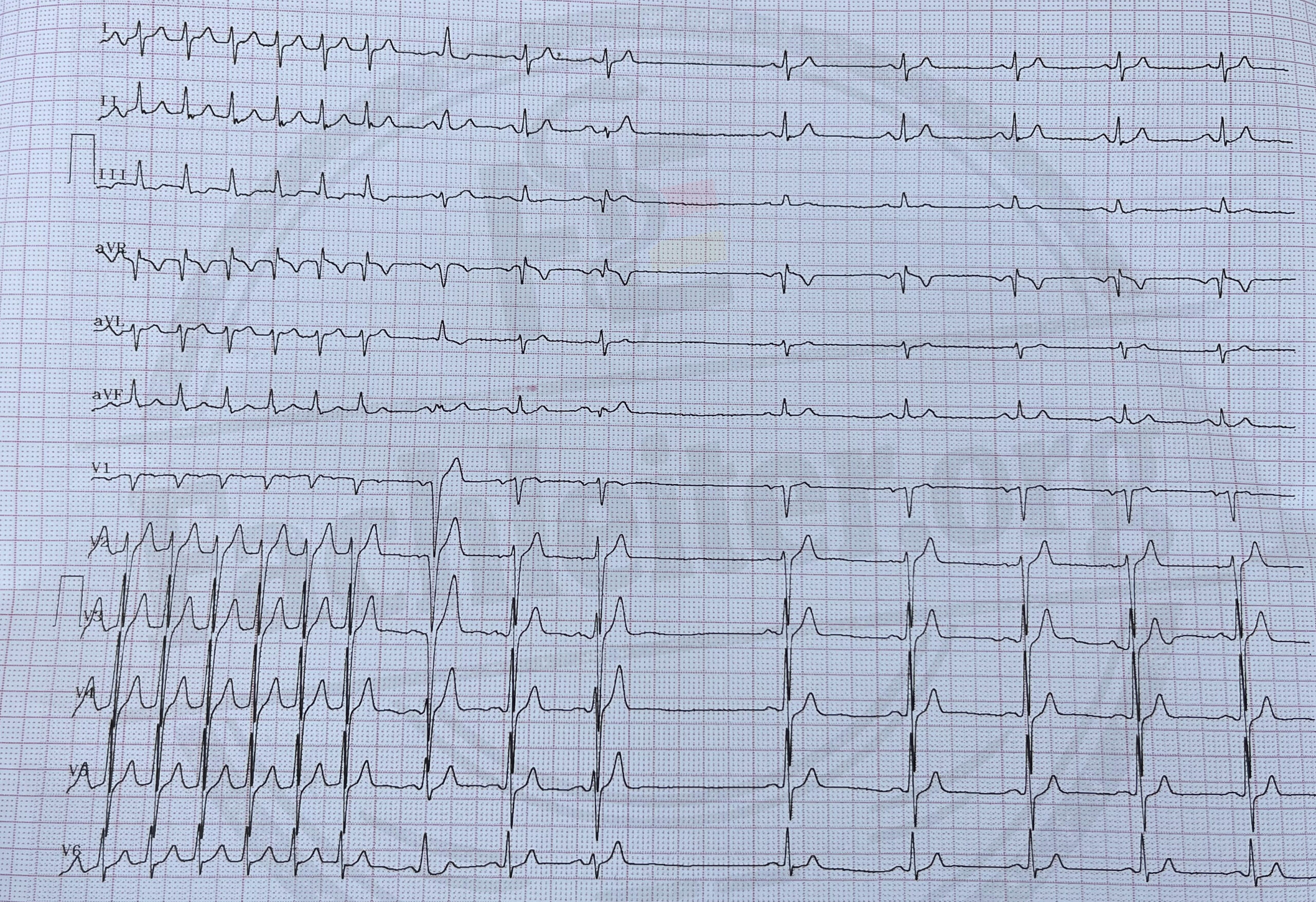
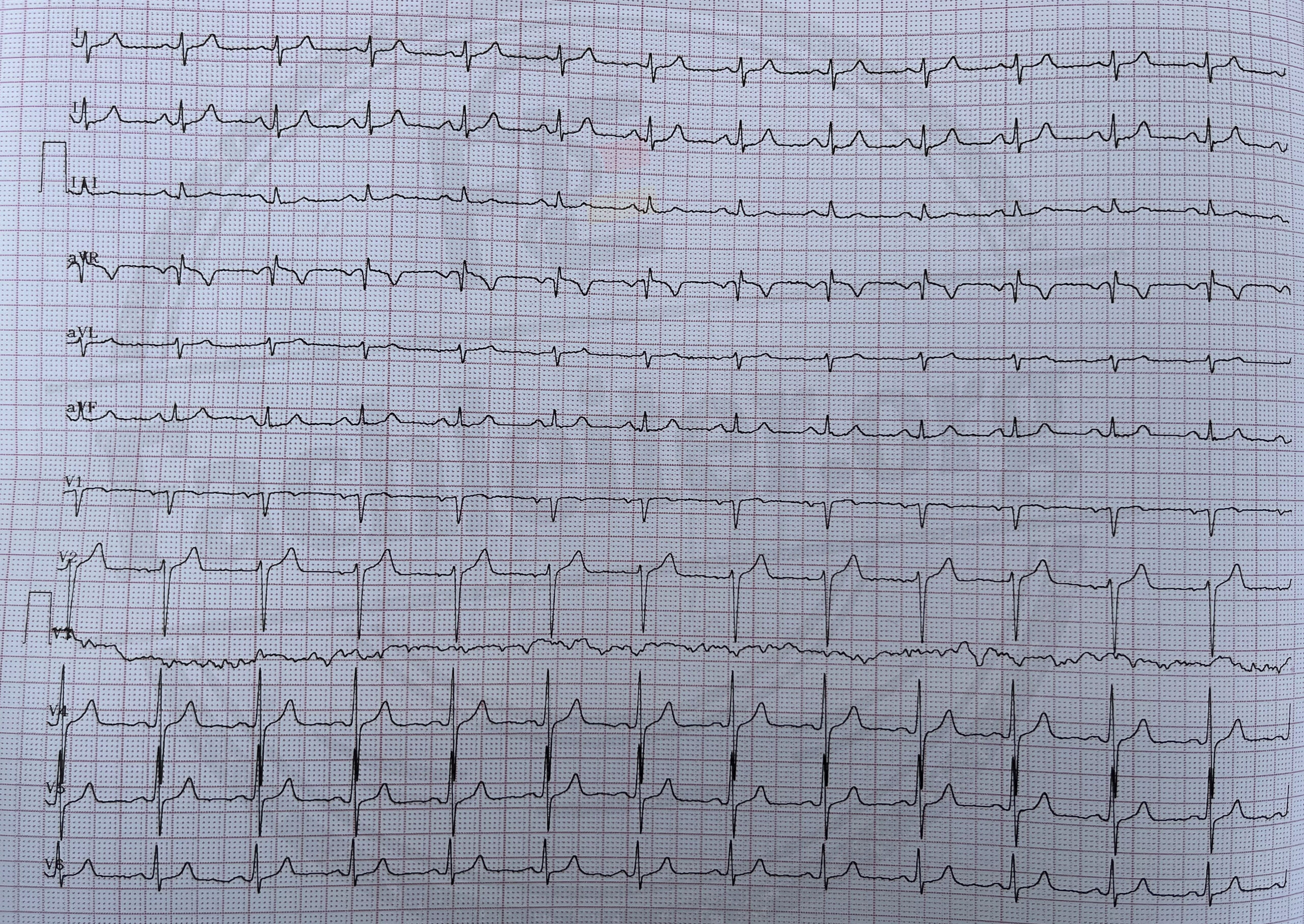
Initially there was a regular narrow-complex tachycardia with a heart rate of 155/min, narrow QRS complexes and P waves not clearly discernible, consistent with an AVNRT. The tachycardia terminated spontaneously. Currently there is a regular sinus rhythm with a heart rate of 75/min.
Laboratory results
| Laboratory parameter | Result | Reference range |
|---|---|---|
| Hämoglobin | 14,6 g/dl | 13,5–17,5 g/dl |
| Leukozyten | 7,8 /nl | 4,0–10,0 /nl |
| Thrombozyten | 248 /nl | 150–400 /nl |
| Natrium | 139 mmol/l | 136–145 mmol/l |
| Kalium | 4,1 mmol/l | 3,5–5,1 mmol/l |
| Kalzium, gesamt | 2,34 mmol/l | 2,15–2,55 mmol/l |
| Magnesium | 0,84 mmol/l | 0,70–1,05 mmol/l |
| Kreatinin | 0,91 mg/dl | 0,67–1,17 mg/dl |
| eGFR | 92 ml/min/1,73 m² | > 60 ml/min/1,73 m² |
| Glukose | 108 mg/dl | 70–140 mg/dl |
| CRP | 1,8 mg/l | < 5,0 mg/l |
| TSH | 1,62 mIU/l | 0,27–4,20 mIU/l |
| fT4 | 1,18 ng/dl | 0,93–1,70 ng/dl |
| hs-Troponin T bei Aufnahme | 7 ng/l | < 14 ng/l |
| hs-Troponin T nach 1 Stunde | 8 ng/l | < 14 ng/l |
Further management
The patient is being admitted to our monitoring ward because of a symptomatic narrow-complex tachycardia persisting for several hours. As the tachycardia terminated spontaneously and a stable sinus rhythm is currently present, acute therapy with adenosine is not required at this time.
Planned measures are:
- continuous ECG monitoring
- regular monitoring of blood pressure, pulse and symptoms
- repeat 12-lead ECG in sinus rhythm
- serial hs‑troponin checks because of the transient chest pressure
- monitoring of blood count, electrolytes, renal and thyroid values
- transthoracic echocardiography, if available on site
The prolonged RR interval of about 1,2 seconds after the tachycardia is not pathological by itself and does not require specific treatment.
If a hemodynamically stable, regular narrow-complex tachycardia recurs, a modified Valsalva maneuver will be performed first. If unsuccessful, adenosine can be administered under continuous ECG monitoring. In the case of circulatory instability, immediate synchronized electrical cardioversion is required.
As our hospital does not have a cardiology or electrophysiology department, a telephone consultation with a cardiology center will take place. If the course is stable and follow-up investigations are unremarkable, the patient can be discharged with a prompt outpatient cardiology appointment. There, a long-term ECG and an echocardiography should be performed. Due to the repeated symptomatic episodes, an electrophysiological study with the option of catheter ablation should also be discussed.
If tachycardia, chest pain, shortness of breath, dizziness or loss of consciousness recur, the patient must present again immediately to the emergency department.