
What is a blood gas analysis?
Blood gas analysis, abbreviated BGA, is a rapid examination of whole blood. It provides important information within minutes about:
- Acid–base balance
- Ventilation and CO₂ elimination
- arterial oxygenation
- tissue perfusion and lactate
- depending on the device, also electrolytes, glucose, hemoglobin and carboxyhemoglobin
The most important measured values are pH, pCO₂ and pO₂. Bicarbonate and base excess are usually calculated from the measured values.
Depending on the sampling site, one distinguishes:
- ABG: arterial blood gas analysis
- VBG: venous blood gas analysis
When is a BGA performed?
A BGA is performed especially in dyspnea, suspected respiratory failure, disturbances of the acid–base balance, shock, sepsis, ketoacidosis and for monitoring oxygen or ventilation therapy.
-
acute exacerbation of COPD
-
severe asthma exacerbation
-
severe pneumonia with respiratory failure
-
diabetic ketoacidosis
-
sepsis or septic shock
How much blood is needed?
Usually about 1–2 ml of whole blood are required in a heparinized BGA syringe. The exact amount depends on the analyzer used.
Which values differ?
| Parameter | Arterial | Peripheral-venous | Practical difference |
|---|---|---|---|
| pH | 7,35–7,45 | about 7.31–7.41 | Venous usually 0.02–0.04 lower |
| pCO₂ | 35–45 mmHg | about 41–51 mmHg | Venous often 3–8 mmHg higher |
| HCO₃⁻ | 22–26 mmol/l | about 23–29 mmol/l | Venous usually slightly higher |
| BE | −2 to +2 mmol/l | similar | Mostly clinically well comparable |
| pO₂ | about 80–100 mmHg | often 30–40 mmHg | Not directly comparable |
| sO₂ | mostly above 95 % | highly variable | Venous not for assessment of oxygenation |
Interpretation
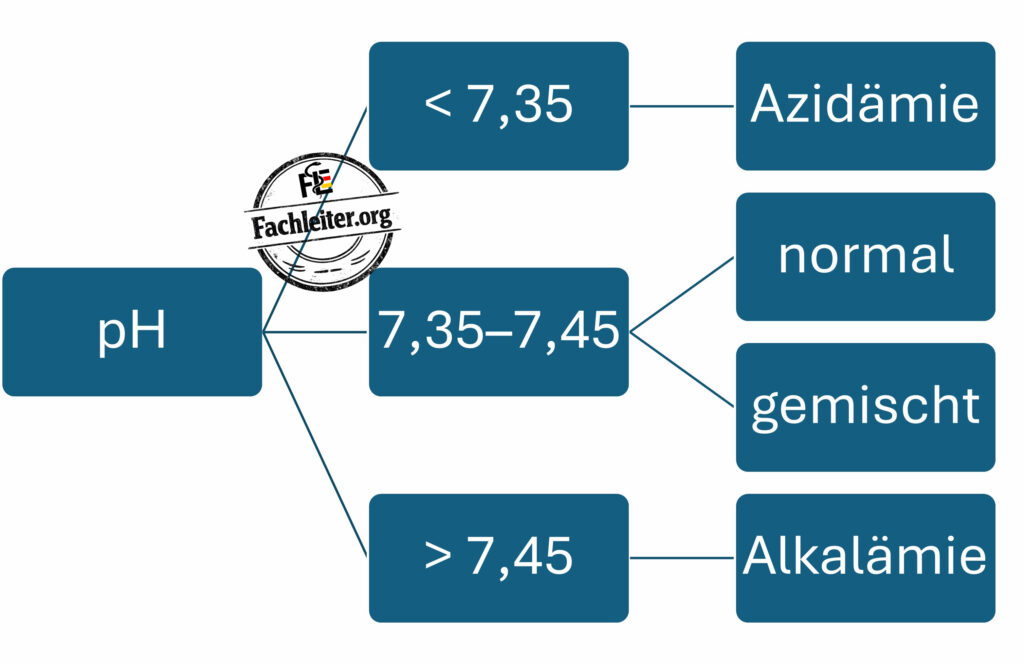
Which change explains the pH value: the pCO₂ or the HCO₃⁻?
If acidemia is present, check:
- Is pCO₂ increased? → respiratory acidosis
- Is HCO₃⁻ decreased? → metabolic acidosis
- Are pCO₂ increased and HCO₃⁻ decreased? → combined respiratory and metabolic acidosis
If alkalemia is present, check:
- Is pCO₂ decreased? → respiratory alkalosis
- Is HCO₃⁻ increased? → metabolic alkalosis
- Are pCO₂ decreased and HCO₃⁻ increased? → combined respiratory and metabolic alkalosis
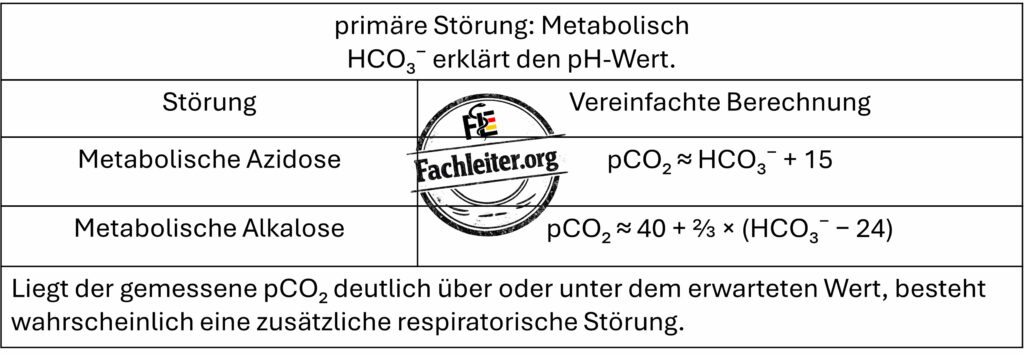
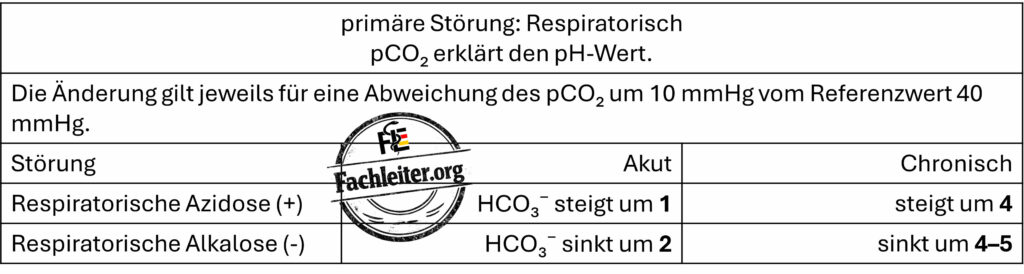
It is essential to determine the primary disorder, i.e. to establish whether the change in pCO₂, HCO₃⁻ or both values explains the pH.
Simplified version
Example
A 31-year-old woman suddenly develops dyspnea and sharp, pleuritic chest pain. She is taking a combined oral contraceptive.
Examination:
Anxious, pulse 118/min, RR 30/min, SpO₂ 88 % on room air.
Creatinine: 0.7 mg/dl
Sample: arterial blood from the A. radialis, room air
- pH: 7,50
- pCO₂: 28 mmHg
- pO₂: 57 mmHg
- HCO₃⁻: 22 mmol/l
- BE: −1 mmol/l
- Lactate: 1.8 mmol/l
Interpretation
- pH 7.50: increased → alkalemia
- pCO₂ 28 mmHg: decreased and explains the alkalemia → primary respiratory alkalosis
- HCO₃⁻ 22 mmol/l: consistent with acute compensation
Calculation:
pCO₂ is decreased by 12 mmHg. In acute respiratory alkalosis HCO₃⁻ decreases by about 2 mmol/l per 10 mmHg pCO₂ fall:
Check compensation
Compensation should move in the correct direction. A markedly stronger or weaker change suggests an additional disorder.
Metabolic acidosis
Winter’s formula:
pCO2, expected = 1.5×HCO3− + 8 ± 2
Metabolic alkalosis
pCO2, expected = 40 + 0.7×(HCO3− − 24) ± 2
Verfügbare Themen
Wählen Sie die Quizze aus, die berücksichtigt werden sollen. Standardmäßig sind alle Themen ausgewählt.