
Medical history / Brief
- Greeting and personal data
- Current complaints
- Accident details
- First measures and course at school
- Accompanying complaints and important negatives
- Previous injuries and pre-existing conditions
- Medications
- Allergies and vaccination status
- School and everyday life
- Additional conversation with the mother
- Summary
👨⚕️ Hello, I’m Dr. Schneider. What’s your name?
👧 My name is Mia.
👨⚕️ Hello Mia. How old are you?
👧 Eight.
👨⚕️ And who came with you today?
👧 My mom.
👨⚕️ I’d like to hear from you first what happened. Your mom can help us afterward if anything is missing. Is that okay?
👧 Yes.
👨⚕️ Mia, do you know how tall you are and how much you weigh?
👧 Not exactly.
👨⚕️ Mrs. Weber, do you know the current measurements?
👩 She’s about 1.28 meters tall and weighs around 25 kilograms.
👨⚕️ Thanks. We’ll weigh Mia again shortly so we can dose the pain medication correctly.
👨⚕️ Where does it hurt?
👧 My finger here.
The girl points to the right index finger.
👨⚕️ Show me with your other hand where it hurts the most.
👧 Here at the front, by the nail.
👨⚕️ Does the finger hurt all the time or only when you move it?
👧 A little all the time. When I move it, it hurts more.
👨⚕️ If zero is no pain and ten is very bad pain: what number fits now?
👧 Four. When moving more like six.
👨⚕️ Has it become better or worse since playing?
👧 At first I thought it would go away. Now it’s also a bit swollen.
👨⚕️ Tell me what happened while playing.
👧 We were playing cops and robbers during recess. I wanted to catch a friend.
👨⚕️ How did you try to catch her?
👧 I ran after her and grabbed her from behind. She kept running, and then my finger suddenly hurt.
👨⚕️ Do you remember if your finger got caught on something or bent?
👧 I don’t remember exactly. It happened very quickly.
👨⚕️ Did you fall down?
👧 No.
👨⚕️ Did anyone step on your hand or did something hit it?
👧 No.
👨⚕️ About when was that?
👧 During the big break.
👩 The school called me about an hour ago. The accident should be about two hours ago now.
👨⚕️ What did you do when the finger started to hurt?
👧 I went to the sink and ran cold water over it.
👨⚕️ Did that help?
👧 A little.
👨⚕️ Did you tell anyone after that?
👧 Not at first.
👨⚕️ And how did your teacher notice then?
👧 We were supposed to write down the homework at the end. I didn’t write. Then she asked why.
👨⚕️ And then you told her about your finger?
👧 Yes. Because I couldn’t hold the pen properly.
👨⚕️ Do you normally write with your right hand?
👧 Yes.
👨⚕️ Did the finger bleed?
👧 No.
👨⚕️ Did you notice anything about the nail, for example blood under it or that it’s loose?
👧 No.
👨⚕️ Does the finger tingle, like little ants crawling over it?
👧 No.
👨⚕️ Does it feel numb anywhere, as if you feel less there?
👧 No.
👨⚕️ Did it get completely cold at times?
👧 No, only under the water.
👨⚕️ Do the other fingers, the hand, or the wrist also hurt?
👧 No, only that one finger.
👨⚕️ Can you still move it a little? You don’t have to show me specifically now.
👧 Yes, but it hurts then.
👨⚕️ Have you ever hurt this hand before or broken something?
👧 No.
👨⚕️ Mrs. Weber, is your daughter known to have any illnesses?
👩 No, she’s otherwise healthy.
👨⚕️ Has she ever been in hospital or had surgery?
👩 No.
👨⚕️ Has Mia already received any pain medication today?
👩 No, so far we’ve only applied cold.
👨⚕️ Does she take any medications regularly?
👩 No.
👨⚕️ Are any allergies known, for example to medications or plasters?
👩 No, not so far.
👨⚕️ Are the usual childhood vaccinations complete?
👩 Yes, as far as I know. I have the vaccination record with me.
👨⚕️ Mia, which grade are you in?
👧 In second grade.
👨⚕️ What do you like to do when you’re not at school?
👧 Gymnastics and painting.
👨⚕️ And who do you live with?
👧 With mom, dad and my little brother.
👨⚕️ Mrs. Weber, Mia has already explained well what happened. I would like to ask you whether you have noticed anything since picking her up.
👩 She holds the hand still and tries not to move the finger. Otherwise she is as usual.
👨⚕️ Has the swelling increased since then?
👩 A little, I would say.
👨⚕️ Has Mia already received a painkiller?
👩 No, we’ve only applied cold so far.
👨⚕️ Has she injured this finger before?
👩 No.
👨⚕️ Are there any pre-existing conditions, regular medications, or known allergies?
👩 No, none of those.
👨⚕️ Do you know if a teacher saw the accident?
👩 I don’t know. The teacher only found out about the pain later and then called me.
👨⚕️ Thank you. I will now examine Mia’s finger and then explain the findings and further steps to both of you.
👨⚕️ Mia, if you think of anything else or have a question, tell me at any time.
👧 Okay.
👨⚕️ Mia, your finger could be sprained or broken. I’ll look at it carefully now. Afterwards we’ll take X-rays so we can see whether a bone is injured. Until then we will keep the finger still. If you have pain, you’ll get an appropriate painkiller. As soon as we have the images, I’ll explain to you and your mom what will happen next.
- Information
- Allergies and intolerances
- Substance use / drugs
- Social history
- Family history
- Medications
- Pre-existing conditions / surgeries
- History of present illness
- Diagnosis – Differential diagnoses
- Further management
Patient: Mia Weber
Age: 8 years
Date: 20.10.2026
Weight / Height: 25 kilograms / 1.28 meters
Dear senior physician,
I would like to present the eight-year-old patient Mia Weber, who was brought in by her mother due to pain in the right index finger after a school accident.
No known allergies or drug intolerances according to the mother.
No relevant self-reported history due to age.
- Pupil in the second grade.
- Right-handed.
- Lives with her parents and her younger brother.
- Leisure activities: gymnastics and painting.
- Accident during school break.
Not further explored in the context of the acute presentation.
- No chronic medication.
- No intake of painkillers prior to presentation.
According to the mother, no chronic illnesses are known. Previous fractures, injuries to the affected finger, surgeries or hospital stays were denied. Vaccination status is complete; the vaccination record is available.
The patient presented with pain in the right index finger lasting about two hours after an accident during the school break.
She reported that she had been playing a game of “cops and robbers” with other children. She tried to hold a classmate who was running in front of her from behind. While the classmate continued running, she suddenly felt pain in the right index finger. She cannot describe the exact mechanism of injury. She denied a fall or a direct blow to the finger.
The pain is mainly localized at the distal phalanx. At rest the pain intensity is about 4/10, with movement up to 6/10 on the numeric rating scale. A slight swelling developed over time.
After the accident she cooled the finger under cold tap water, which temporarily improved the symptoms. Initially she did not tell her teacher about the incident. Only when she failed to note the homework at the end of class did the teacher become aware. The patient stated that she was unable to hold the pen properly due to the pain.
Bleeding, visible nail injury, paresthesias or numbness were denied. There is no pain in other fingers or in the rest of the hand or wrist.
The mother added that her daughter has been protecting the right hand since being picked up. Apart from the finger-related complaints she behaves as usual.
Due to the acute post-traumatic pain and reported swelling, there is suspicion of a bony injury of the right index finger, particularly a distal phalanx fracture. Involvement of the growth plate should be considered.
Differential diagnoses include contusion, sprain, and ligament or tendon injury.
First, a clinical examination of the affected finger including adjacent parts of the hand is planned. Skin and nail bed, swelling, tenderness and possible deformities as well as active mobility and tendon function should be assessed. Peripheral perfusion and sensation are also to be checked.
To clarify a possible fracture, X-rays of the right index finger in at least two planes are planned. Until further clarification, provisional immobilization, elevation and gentle cooling should be performed. Weight-adapted analgesia is planned if necessary.
Further management depends on clinical and radiological findings. The patient and her mother will be informed about the planned examinations and next steps.
Physical examination
The eight-year-old patient is alert, responsive and in good general condition. She is protecting the right hand.
-
Inspection: Slight swelling of the distal phalanx of the right index finger. No open wound, visible axial deviation or deformity. Nail plate correctly positioned, no visible subungual hematoma.
-
Palpation: Localized tenderness over the distal phalanx. No tenderness over the middle and proximal phalanges, the other fingers, the metacarpus or the wrist.
-
Mobility and tendon function: Active flexion and extension in all finger joints possible, but limited at the distal joint due to pain. No active extension deficit. Gentle flexion shows no evidence of rotational deformity.
-
Perfusion: Finger warm and pink, capillary refill time under two seconds.
-
Sensation: Touch sensation symmetric and intact, no numbness or paresthesias.
In summary, there is a painful swelling with localized tenderness over the distal phalanx with preserved perfusion, sensation and active tendon function. A fracture cannot be excluded clinically.
X-ray
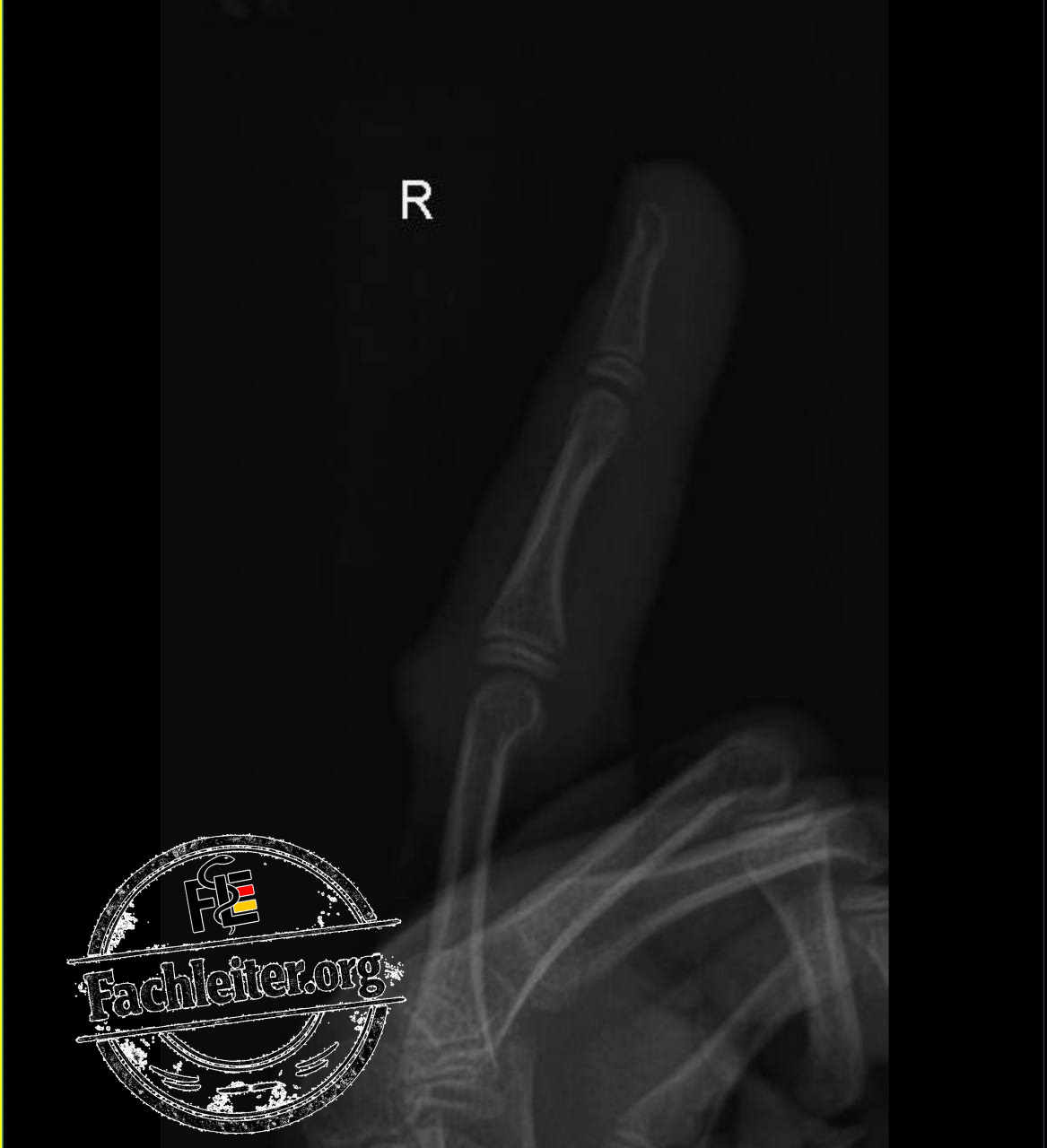
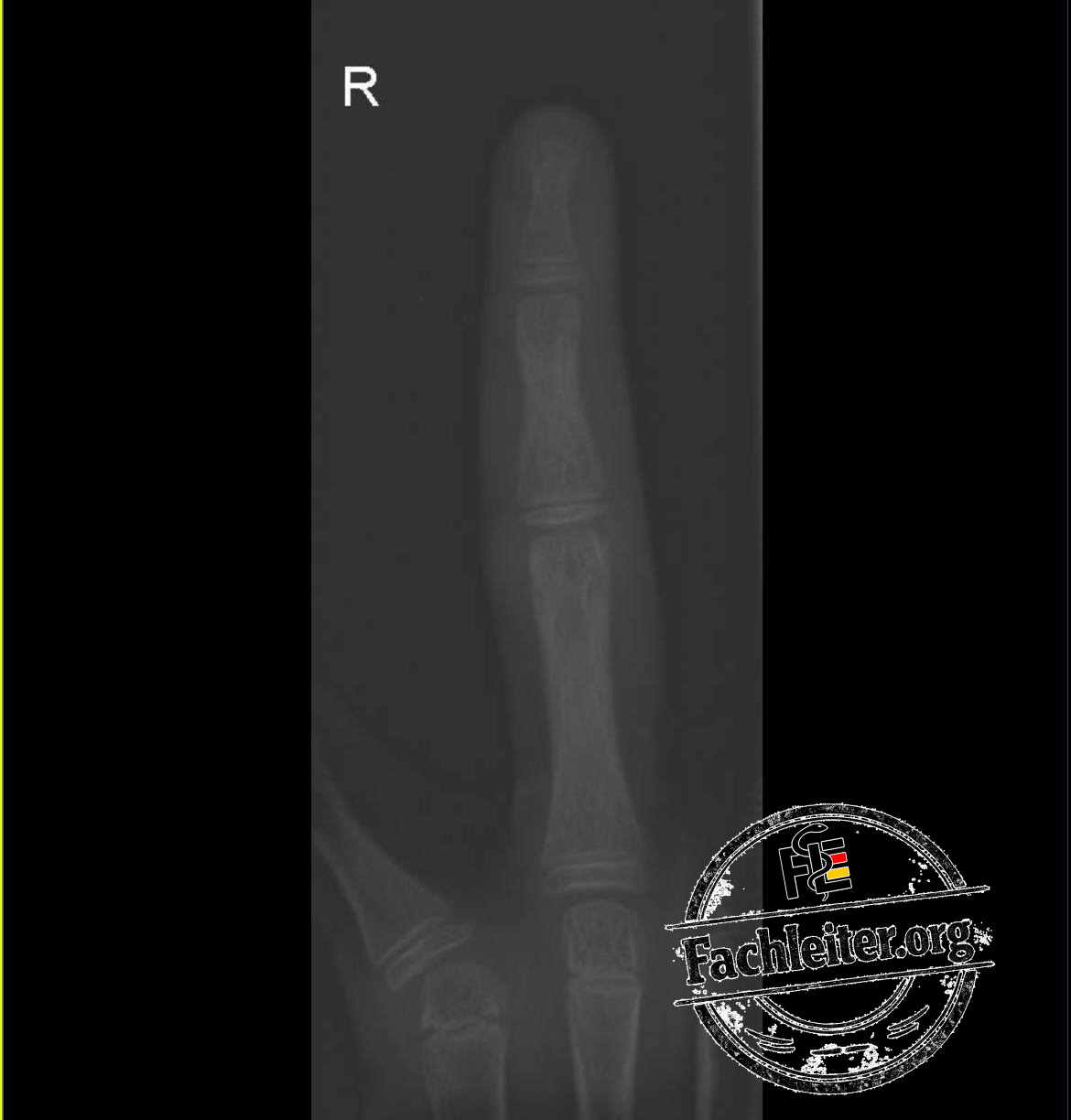
Interpretation
The X-rays of the right index finger in two planes show a non-displaced fracture of the distal phalanx without relevant axial deviation. No involvement of the growth plate. Joint alignment is normal.
Further management
After consultation with the treating orthopedist, conservative treatment was agreed:
- Immobilization: Fitting with a padded finger splint including the distal joint for an estimated 3–4 weeks. The middle joint remains free to move. Final duration depends on the healing course.
- Analgesia: Ibuprofen oral suspension, 40 mg/ml. For a body weight of 25 kg: 5 ml (= 200 mg; corresponds to a leveled 5-ml measuring spoon) as needed up to three times daily, with at least six hours between doses. Initially for a maximum of three days. If painkiller need persists, reassessment by a physician.
- Anti-swelling measures: Elevation and short-term cooling with an ice pack wrapped in a cloth.
- Follow-up: After splint application, recheck perfusion, sensation and splint fit. Clinical follow-up after about one week; X-ray checks as determined by trauma surgery.
- Activity: No school sports, gymnastics or strenuous play until medical clearance. The joints not immobilized should be moved regularly.
- Return visit: If increasing pain, numbness, a cold or discolored finger or pressure sores from the splint occur, return immediately.
The patient and her mother were informed about the treatment and care of the splint.
Splint care
-
Keep clean and dry: Protect the splint from water when washing. Replace damp or soiled padding.
-
Check fit: The splint should neither press nor slip. Do not fasten straps too tightly.
-
Watch the skin: Look for redness, pressure points or blisters. Do not insert objects under the splint to scratch.
-
Check the finger: The fingertip should be warm and normally colored. If pain increases, or there is tingling, numbness or a cold, pale or blue finger, seek medical attention immediately.
-
Do not alter yourself: Do not cut, bend or permanently remove the splint yourself. Remove and clean only as shown by a physician.
-
Stay mobile: Gently move the joints that are not immobilized regularly. Keep the injured hand elevated as much as possible initially.
Question
When is surgical treatment required for a pediatric finger fracture?