Headache is one of the most common reasons for presentation in hospital and outpatient practice. This article conveys the most important differential diagnoses, the distinction between migraine, tension-type headache and cluster headache, as well as warning signs (red flags) for secondary headaches such as subarachnoid hemorrhage, meningitis, brain tumors or giant cell arteritis. Ideal for preparation for the Fachsprachprüfung (FSP), Kenntnisprüfung (KP), M3 and clinical everyday practice.
Headache – Migraine
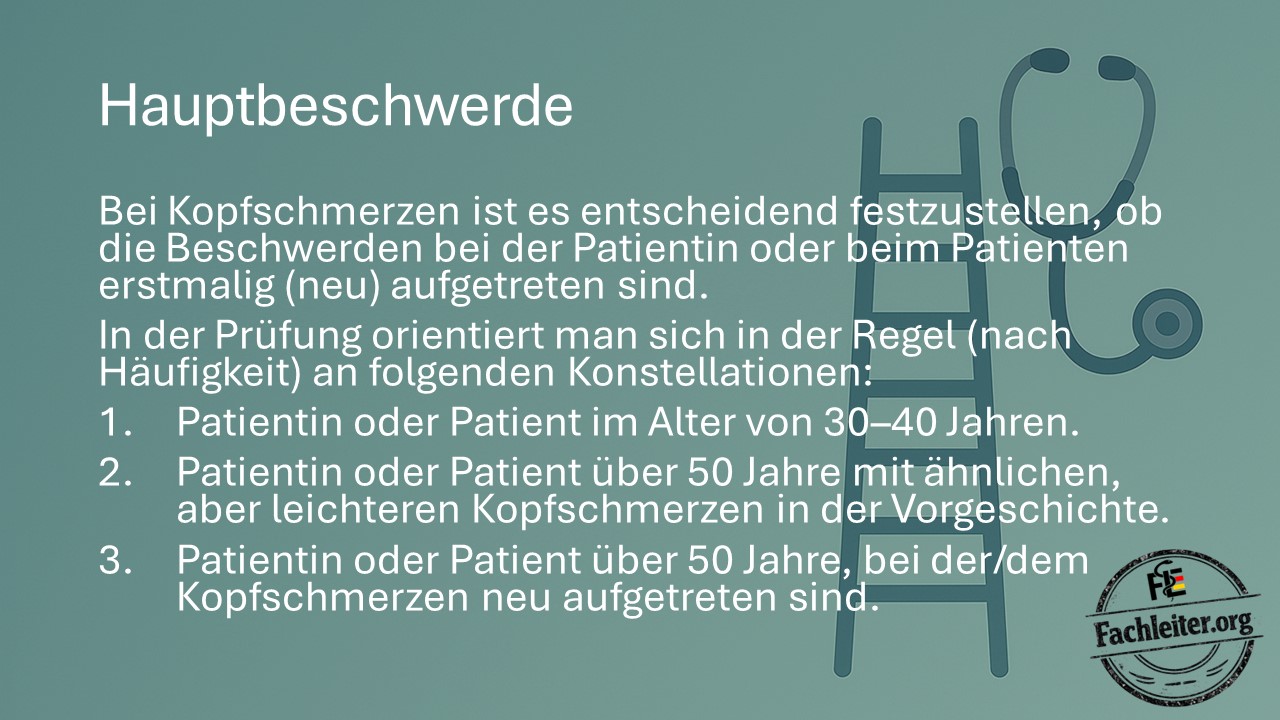
Main complaints
When assessing headaches, it is crucial to determine whether the complaints are new or have occurred previously.
In the Fachsprachprüfung one often orients to the following scenarios:
- Patient aged 30–40 years.
- Patient over 50 years with similar but milder headaches in the medical history.
- Patient over 50 years with newly onset headaches.
Differential diagnoses
First, the characteristics of the headaches should be asked about to better classify primary headaches (migraine, tension-type headache and cluster headache).
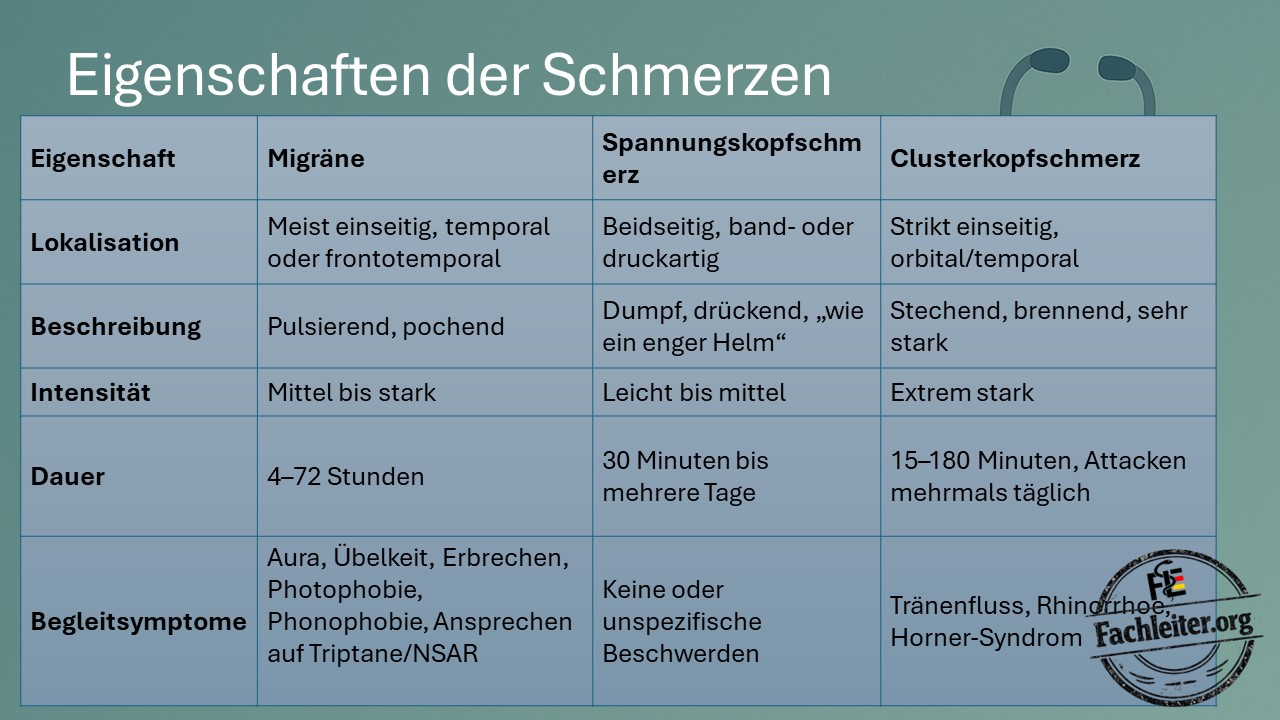
Features
| Feature | Migraine | Tension-type headache | Cluster headache |
|---|---|---|---|
| Location | Usually unilateral, temporal or frontotemporal. | Bilateral, band-like or pressing. | Strictly unilateral, orbital or temporal. |
| Character | Pulsating, throbbing. | Dull, pressing (“like a tight helmet”). | Stabbing, burning, extremely severe. |
| Intensity | Moderate to severe. | Mild to moderate. | Very severe. |
| Duration | 4–72 hours. | 30 minutes to several days. | 15–180 minutes, several times daily. |
| Associated symptoms | Aura, nausea, vomiting, photophobia, phonophobia, good response to triptans or NSAIDs. | No or only nonspecific accompanying complaints. | Tearing, rhinorrhea, Horner’s syndrome. |
Secondary headaches
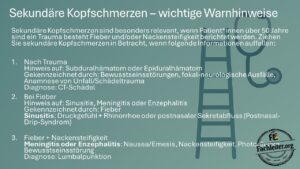
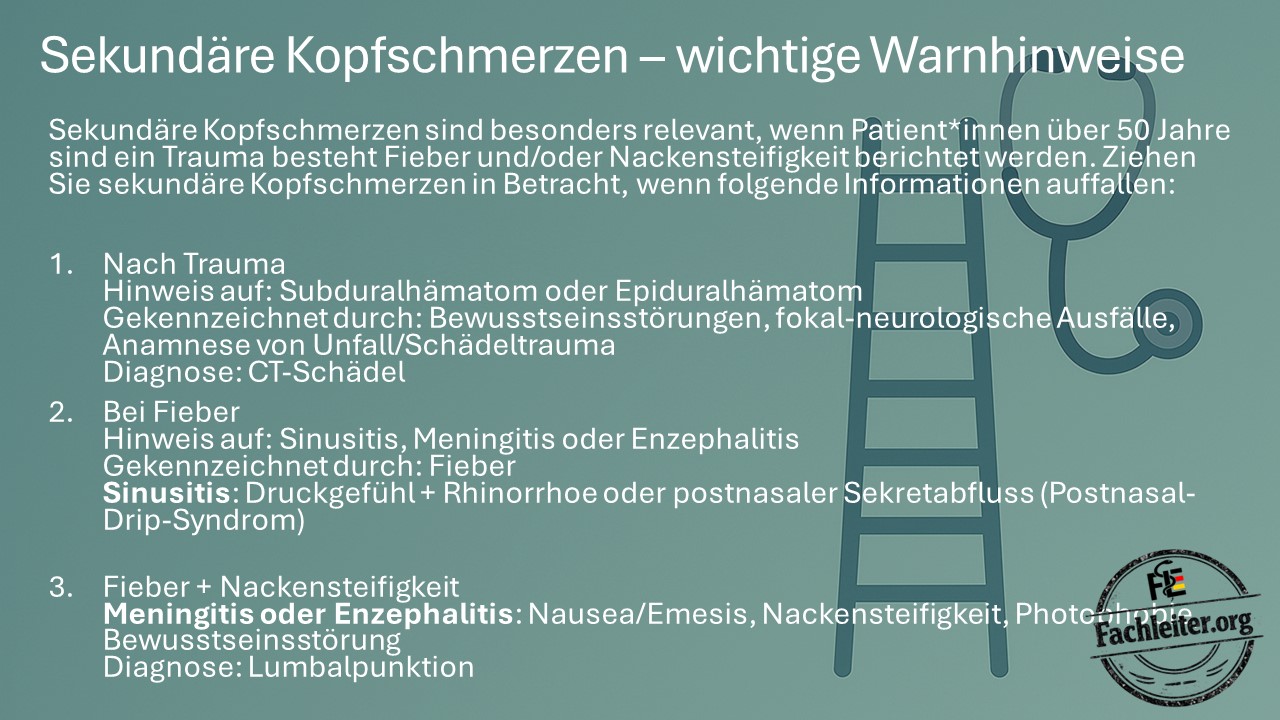
Secondary headaches must especially be excluded in the following situations:
1. After trauma
- Suspected subdural hematoma or epidural hematoma.
- Impaired consciousness or focal neurological deficits.
- History of head trauma.
- Diagnostics: Head CT.
2. Headache with fever
- Sinusitis
- Meningitis
- Encephalitis
Sinusitis: Pressure sensation, rhinorrhea or postnasal drip.
3. Fever and neck stiffness
- Suspected meningitis or encephalitis.
- Nausea, vomiting, photophobia and altered consciousness.
- Diagnostics: Lumbar puncture.
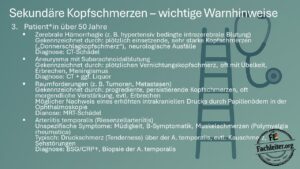
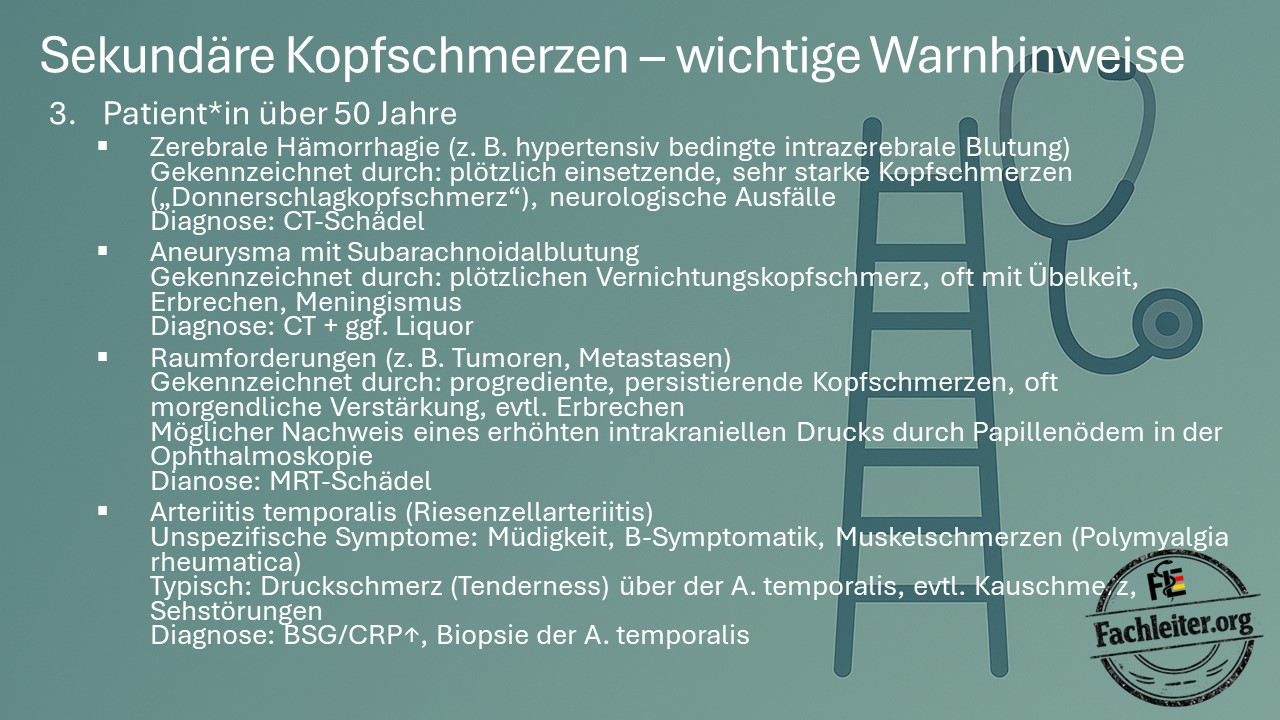
4. Newly onset headaches in patients over 50 years
-
Cerebral hemorrhage
- Sudden onset thunderclap headache.
- Neurological deficits.
- Diagnostics: Head CT.
-
Subarachnoid hemorrhage from an aneurysm
- Sudden thunderclap headache.
- Nausea, vomiting, meningismus.
- Diagnostics: Head CT, possibly CSF analysis.
-
Space-occupying lesion (tumor, metastases)
- Progressive headaches.
- Worse in the morning.
- Vomiting.
- Papilledema.
- Diagnostics: Brain MRI.
-
Temporal arteritis (giant cell arteritis)
- Fatigue, B symptoms, muscle pain.
- Tenderness over the temporal artery.
- Jaw claudication.
- Visual disturbances.
- Diagnostics: ESR, CRP and temporal artery biopsy.
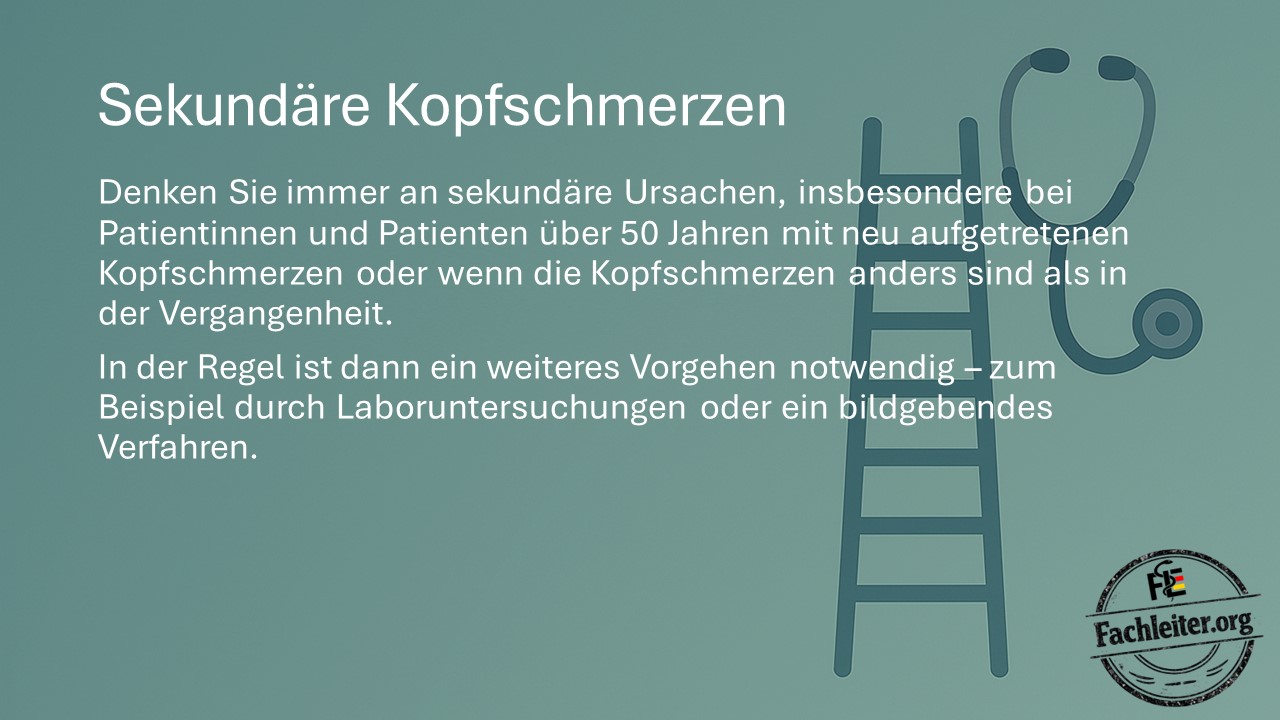
Note
Always consider secondary causes, especially with newly onset headaches in patients over 50 years or if the headaches differ markedly from previous episodes.
In these cases, further investigations such as laboratory tests or imaging are usually required.
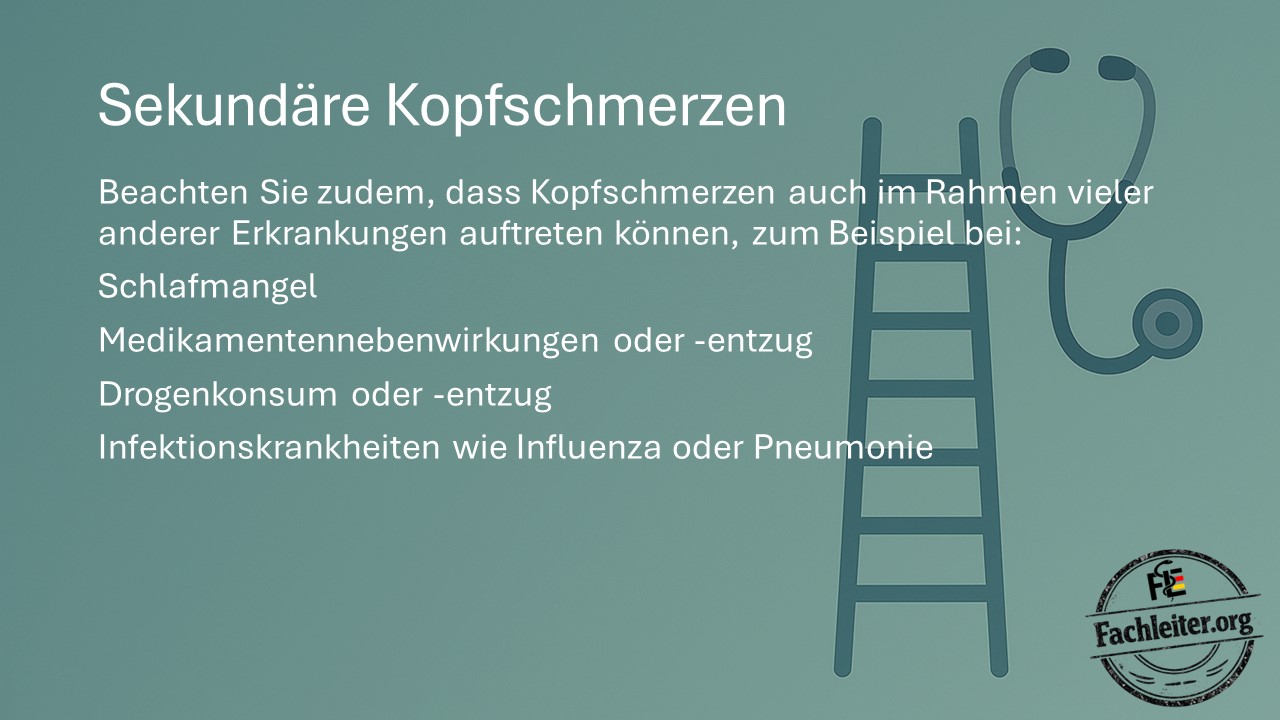
Other possible causes
- Sleep deprivation
- Medication side effects or medication withdrawal
- Drug use or drug withdrawal
- Infectious diseases (e.g., influenza or pneumonia)