
Medical history interview
- Greeting and brief introduction
- Personal data
- Current complaints
- Neurological complaints
- Past medical history
- Operations and hospital stays
- Medications
- Allergies and intolerances
- Gynecological history
- Social history
- Substances and drugs
- Family history
- Conclusion and counseling
👨⚕️ Hello, my name is Dr. Schneider. I am responsible for you today. Before we begin: how would you like me to address you?
👩 Hello. My name is Helga Müller.
👨⚕️ Ms. Müller, I would first like to ask you some questions about your complaints and your health. Is that okay with you?
👩 Yes, of course.
👨⚕️ How old are you?
👩 I am 70 years old.
👨⚕️ How tall are you and how much do you weigh?
👩 I am 1.65 meters tall and weigh about 72 kilos.
👨⚕️ Who do you currently live with?
👩 I live with my husband.
👨⚕️ Who is your primary care physician?
👩 Dr. Weber. Unfortunately I don’t have the phone number with me.
👨⚕️ What brings you to us today?
👩 I have felt restless inside for a few hours.
👨⚕️ Can you describe this restlessness in more detail?
👩 That’s hard to explain. I feel very unsettled inside and can’t really relax.
👨⚕️ When did the complaints start?
👩 About three hours ago.
👨⚕️ Did they start suddenly or rather slowly?
👩 Actually quite suddenly.
👨⚕️ What were you doing when the complaints began?
👩 I was sitting at home on the sofa watching television.
👨⚕️ Was there any specific trigger? Were you upset or physically exerted?
👩 No, not at all.
👨⚕️ Has the restlessness been constant since then?
👩 Yes, it has been there the whole time.
👨⚕️ Has it gotten better or worse?
👩 It’s been about the same.
👨⚕️ Have you noticed palpitations or skipped beats?
👩 No, not really. I haven’t particularly felt my heart.
👨⚕️ Do you have chest pain, pressure, or tightness?
👩 No.
👨⚕️ Are you short of breath?
👩 No, I can breathe normally.
👨⚕️ Have you been dizzy or fainted?
👩 No.
👨⚕️ Have you had nausea, vomiting, or unusually heavy sweating?
👩 No.
👨⚕️ Have you had such complaints before?
👩 No, I can’t remember that.
👨⚕️ Have you noticed any new weakness or numbness?
👩 No. My left arm has been somewhat weaker since my stroke, but today it’s no different than usual.
👨⚕️ Do you have speech problems, visual disturbances, or severe headaches?
👩 No.
👨⚕️ When did you have the stroke?
👩 About six months ago.
👨⚕️ Have any deficits remained since then?
👩 Only the slight weakness in the left arm. I manage well in everyday life.
👨⚕️ Which diseases are known in your medical history?
👩 I have diabetes and had a stroke six months ago.
👨⚕️ Since when have you had diabetes?
👩 For about twelve years.
👨⚕️ Do you also have high blood pressure, a thyroid disorder or a heart disease?
👩 Not that I know of.
👨⚕️ Has a cardiac arrhythmia ever been diagnosed?
👩 No.
👨⚕️ Have you ever had surgery?
👩 Yes, my gallbladder was removed about ten years ago.
👨⚕️ Were there any complications?
👩 No, everything went well.
👨⚕️ Apart from the stroke and the operation, have you been hospitalized for other reasons?
👩 No.
👨⚕️ Which medications do you take regularly?
👩 I’m not sure. I take several tablets in the morning and evening, but I can’t remember the names.
👨⚕️ Do you take pills or insulin for your diabetes?
👩 I take pills. I do not inject insulin.
👨⚕️ Do you know whether you have been taking an anticoagulant since the stroke?
👩 I have been taking an additional tablet since then, but I don’t know whether it’s an anticoagulant.
👨⚕️ Do you have your medication list with you?
👩 No, it’s at home.
👨⚕️ Can we call your husband or your GP to clarify your medications?
👩 Yes, you may call my husband.
👨⚕️ Do you have allergies or do you not tolerate certain medications?
👩 I once got a skin rash from penicillin.
👨⚕️ Did you also have shortness of breath or swelling?
👩 No, only an itchy rash.
👨⚕️ Do you have other allergies, for example to foods, plasters or contrast agents?
👩 Not that I know of.
👨⚕️ I would now like to ask you some routine gynecological questions. When was your last menstrual bleeding?
👩 At about 51 years. I haven’t had menstrual bleeding since then.
👨⚕️ Have you had any vaginal bleeding since then?
👩 No.
👨⚕️ Have you ever been pregnant?
👩 Yes, twice.
👨⚕️ Did you deliver both children vaginally?
👩 Yes, both births were without major problems.
👨⚕️ Are gynecological diseases or surgeries known to you?
👩 No.
👨⚕️ Do you go regularly for gynecological check-ups?
👩 Yes, about once a year.
👨⚕️ You said you live with your husband. Do you have children?
👩 Yes, I have a son and a daughter. Both live nearby.
👨⚕️ Do you need help in everyday life?
👩 No, I can care for myself. My husband only helps sometimes with carrying heavy things.
👨⚕️ What did you do professionally?
👩 I was an elementary school teacher. I have been retired for several years.
👨⚕️ Are there stairs at home?
👩 Yes, we live on the first floor. There is no elevator, but I can manage the stairs well.
👨⚕️ Do you smoke?
👩 No. I also never smoked regularly in the past.
👨⚕️ Do you drink alcohol?
👩 Occasionally a glass of wine, maybe once or twice a month.
👨⚕️ Do you use drugs or other stimulants?
👩 No.
👨⚕️ Do you drink a lot of coffee or energy drinks?
👩 I drink two cups of coffee in the morning. I don’t drink energy drinks.
👨⚕️ Are there cardiovascular diseases in your family?
👩 My father had a heart attack at age 68.
👨⚕️ Did anyone in your family have a stroke or an arrhythmia?
👩 My mother had a stroke at an advanced age. I don’t know of any arrhythmias.
👨⚕️ Is there diabetes, cancer or other important diseases in your family?
👩 My mother also had diabetes. I’m not aware of cancers.
👨⚕️ I would like to briefly explain the further procedure. Various causes can underlie internal restlessness, for example a metabolic disorder, an infection or a cardiovascular disease. At this time we cannot make a definite diagnosis.
First I will examine you physically and check your blood pressure, pulse, blood glucose and oxygen saturation. Then we will record an ECG to assess your heart rhythm. Depending on the results, further tests, for example a blood draw or a cardiac ultrasound, may be necessary.
Vital parameters and examination
- Blood pressure: 130/80 mmHg
- Pulse rate: 140/min
- Respiratory rate: 14/min
- Oxygen saturation: 98 %
- Blood glucose: 240 mg/dl
ECG evaluation
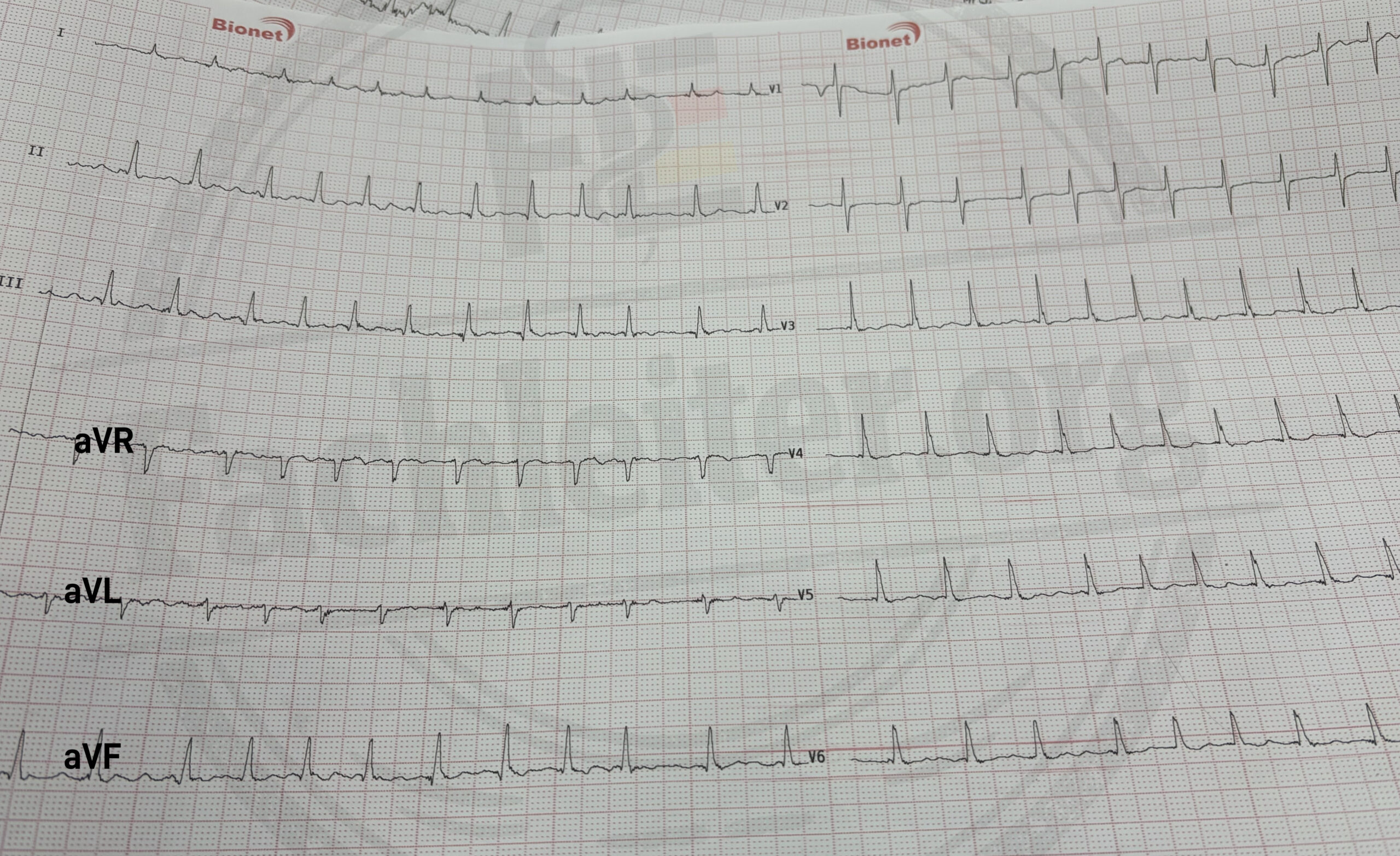
The combination of the following findings is indicative of atrial fibrillation:
- absolutely irregular rhythm
- absence of distinct P waves
- irregular RR intervals
- narrow QRS complexes
- increased ventricular rate
Conclusion: atrial fibrillation with high ventricular rate
How should the ST segments be assessed?
Assessment of the ST segments is hampered at a heart rate of about 140–150/min. There are several reasons for this:
- shortened RR intervals
- superimposition by fibrillation waves
- possible rate-related ST-T changes
- limited distinction between ST segment and T wave
Nevertheless, ST changes must not automatically be considered harmless. With suspicious symptoms or conspicuous ECG changes, myocardial ischemia and an acute coronary syndrome must in particular be excluded.
| Laboratory parameter | Result | Reference range |
|---|---|---|
| Hemoglobin | 13,1 g/dl | 12,0–16,0 g/dl |
| Hematocrit | 39 % | 36–46 % |
| Leukocytes | 7,8/nl | 4,0–10,0/nl |
| Platelets | 245/nl | 150–400/nl |
| CRP | 2,4 mg/l | < 5 mg/l |
| Sodium | 138 mmol/l | 135–145 mmol/l |
| Potassium | 4,1 mmol/l | 3,5–5,1 mmol/l |
| Magnesium | 0,68 mmol/l | 0,70–1,05 mmol/l |
| Calcium | 2,28 mmol/l | 2,15–2,55 mmol/l |
| Creatinine | 0,89 mg/dl | 0,50–0,90 mg/dl |
| eGFR | 68 ml/min/1,73 m² | ≥ 60 ml/min/1,73 m² |
| Urea | 34 mg/dl | 17–43 mg/dl |
| Glucose | 240 mg/dl | 70–100 mg/dl fasting |
| HbA1c | 8,2 % | < 6,5 % |
| Ketone bodies | negative | negative |
| TSH | 1,6 mIU/l | 0,4–4,0 mIU/l |
| hs-Troponin T initial | 11 ng/l | < 14 ng/l |
| hs-Troponin T after 1 hour | 12 ng/l | < 14 ng/l |
| CK | 82 U/l | < 170 U/l |
| GOT (AST) | 22 U/l | < 35 U/l |
| GPT (ALT) | 25 U/l | < 35 U/l |
| γ-GT | 28 U/l | < 40 U/l |
| Total bilirubin | 0,7 mg/dl | < 1,2 mg/dl |
| INR | 1,1 | 0,9–1,2 |
| Quick | 92 % | 70–130 % |
| aPTT | 30 s | 25–35 s |
Acute therapy
For rate control the hemodynamically stable patient received Metoprolol 50 mg orally. Heart rate, blood pressure and clinical status were then monitored closely.
Before administration, possible contraindications such as hypotension, acute decompensated heart failure, a high-grade AV block or severe bronchial asthma must be considered. Further dosing depends on clinical response.
Stroke risk and anticoagulation
The current CHA₂DS₂-VA score is at least 4 points:
- Age between 65 and 74 years: 1 point
- Diabetes mellitus: 1 point
- Previous stroke: 2 points
Using the previously commonly used CHA₂DS₂-VASc score, including female sex yields 5 points.
Thus there is a very high risk for further thromboembolic events and in principle a clear indication for long-term oral anticoagulation, provided no contraindications exist.
Before prescribing, however, the following must be clarified:
- Is the patient already taking an anticoagulant?
- Was the medication taken regularly?
- What is the renal function?
- Is there an increased bleeding risk?
- Is there a mechanical heart valve or relevant mitral stenosis?
- Are there possible interactions with other medications?
A double anticoagulation must absolutely be avoided.
Further management
After administration of Metoprolol 50 mg p.o. the heart rate decreased to about 90/min. The patient remained hemodynamically stable and the inner restlessness improved.
The control ECG still shows atrial fibrillation, but now with adequate rate control. There are no relevant ST-segment changes and therefore no current electrocardiographic evidence of acute myocardial ischemia. Serial troponin values also show no relevant dynamics.
Next steps
- Continue monitoring heart rate, blood pressure and oxygen saturation
- Clarify prior Metoprolol therapy and determine further dosing
- Continue existing anticoagulation with Apixaban
- Verify Apixaban dosing, regular intake and timing of last dose
- Correct the slightly reduced magnesium level
- Control and further treatment of elevated blood glucose values
- Perform transthoracic echocardiography to assess cardiac function, valves and possible structural heart disease
- Decide on later rhythm control or cardioversion
As we do not have a cardiology department, the patient will be referred to an internal medicine or cardiology clinic for further evaluation. The ECG recordings, laboratory results and the current medication list will be provided.
Immediate electrical cardioversion is not required in this stable and now rate-controlled patient. Before a planned cardioversion, the actual duration of atrial fibrillation and reliable intake of Apixaban must be clarified.
If the condition remains stable, with adequate rate control, confirmed anticoagulation and unremarkable further diagnostics, outpatient cardiology follow-up can subsequently be carried out.