
History
A 70-year-old patient presents with nausea, a pressure sensation in the epigastrium and general malaise.
Further gastrointestinal symptoms such as vomiting, diarrhea, constipation, heartburn, hematemesis, melena or severe abdominal pain are denied.
Cardiac accompanying symptoms such as retrosternal pain, radiation to the left arm or lower jaw, dyspnea, palpitations, cold sweats or syncope are also denied.
Neurological symptoms such as headache, dizziness, visual disturbances, speech disturbances, paralysis or consciousness disorders are not present.
No cases of influenza or gastroenteritis are known in the patient’s personal environment.
Pre-existing conditions
- Coronary artery disease
- History of myocardial infarction
- Status post coronary artery bypass grafting three years ago
- Arterial hypertension
- Hypercholesterolemia
Long-term medication
- Acetylsalicylic acid 100 mg einmal täglich
- Atorvastatin 40 mg einmal täglich
- Ramipril 5 mg einmal täglich
- Bisoprolol 2,5 mg einmal täglich
- Pantoprazol 40 mg einmal täglich
The patient is a non-smoker and does not consume alcohol.
Vital signs
- Blood pressure: 145/85 mmHg
- Heart rate: 75/min
- Respiratory rate: 16/min
- Oxygen saturation: 97 % on room air
- Body temperature: 36,7 °C
- GCS: 15 points
The patient is awake, fully oriented and hemodynamically stable. The abdomen is soft and without guarding. There is at most slight tenderness in the epigastrium.
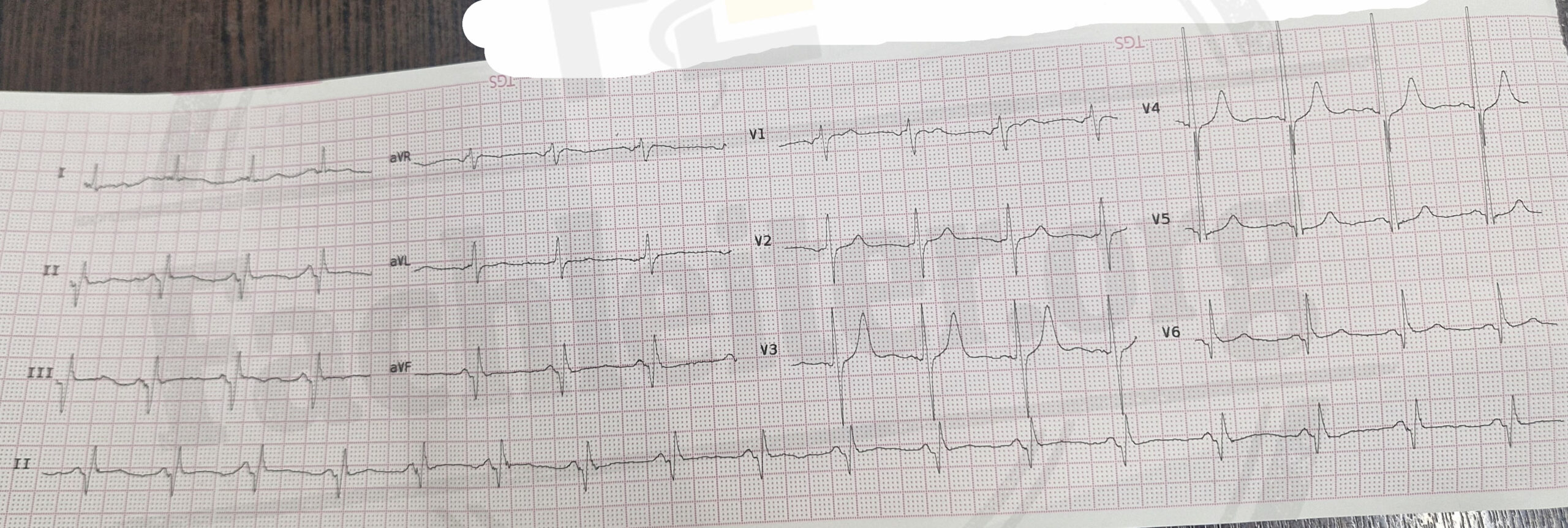
ECG summary
Regular sinus rhythm with a heart rate of approximately 75/min. Pathological Q waves in II, III and aVF indicating a previous inferior myocardial infarction. Additionally there is a pathological Q wave in aVL. No definite signs of acute myocardial ischemia.
| Parameter | Result | Reference range |
|---|---|---|
| High-sensitivity Troponin T | 9 ng/l | < 14 ng/l |
| Hemoglobin | 14,2 g/dl | 13,5–17,5 g/dl |
| Leukocytes | 7,8/nl | 4,0–10,0/nl |
| Platelets | 238/nl | 150–400/nl |
| Sodium | 139 mmol/l | 135–145 mmol/l |
| Potassium | 4,2 mmol/l | 3,5–5,1 mmol/l |
| Creatinine | 0,96 mg/dl | 0,70–1,20 mg/dl |
| eGFR | 82 ml/min/1,73 m² | ≥ 60 ml/min/1,73 m² |
| AST (GOT) | 24 U/l | < 50 U/l |
| ALT (GPT) | 27 U/l | < 50 U/l |
| γ-GT | 31 U/l | < 60 U/l |
| Total bilirubin | 0,7 mg/dl | < 1,2 mg/dl |
| Lipase | 36 U/l | 13–60 U/l |
| Glucose | 108 mg/dl | <140 mg/dl* |
| CRP | 1,8 mg/l | < 5 mg/l |
About 50 minutes after admission the patient reports newly onset colicky abdominal pain and a single episode of vomiting of food remnants.
He also speaks on the phone with his son. During the call he learns that his grandchild has been suffering from abdominal pain and diarrhea since yesterday. The last contact with the grandchild had taken place 3 five days ago.
Clinical decision
The newly developed colicky abdominal pain and the vomiting make a gastrointestinal cause more likely. Nevertheless, in this 70-year-old patient with known coronary artery disease and prior bypass surgery one must not prematurely assume gastroenteritis.
Therefore a second ECG is recorded during the symptoms. This shows no dynamic changes compared to the admission ECG and no signs of acute myocardial ischemia.
Although the symptoms have been present for about ten hours, a single hs-Troponin T value of 9 ng/l is not sufficient for a reliable single-sample exclusion. Therefore a control measurement is performed after one hour. The hs-Troponin T is now 10 ng/l and shows no relevant dynamic with a difference of 1 ng/l. Thus there is no laboratory indication of an acute myocardial infarction.
With stable general condition, unremarkable follow-up examinations and regressing symptoms, the patient is discharged to outpatient care with the suspected diagnosis of early acute viral gastroenteritis.
For treatment of nausea/emesis he receives a single dose of 4 mg Ondansetron intramuscularly (i. m.). He is instructed to prevent dehydration by adequate fluid intake. He should regularly drink small amounts of water, tea or electrolyte solution.
He should return immediately to the emergency department in case of high fever, persistent or severe diarrhea, blood in the stool, repeated vomiting, increasing abdominal pain, reduced urine output, shortness of breath or chest pain.
Additionally, the patient is informed about measures to avoid transmission. These include thorough hand washing with water and soap, use of personal towels, regular cleaning of the toilet and frequently touched surfaces, and refraining from preparing food for others for at least 48 hours after symptom resolution.